Showing posts with label battlefield. Show all posts

Thursday, October 24, 2013

Richmond

Richmond, Virginia is an old city. Living in the Midwest, we can often overlook the fact that when we consider "old", say early 19th century, the east coast has places 200 years older than that. The locality we know as Richmond is a case in point. There was a settlement in the vicinity in 1609. The present city was founded in 1737.The James River runs just south of the downtown. Carole lives in a suburb and commutes about 15 minutes into downtown Richmond.

It's rather ironic that, in 2001, we visited Richmond for her post-high school graduation Civil War battlefields vacation. We stayed at a luxury hotel right off capitol square in downtown. (The hotel is still there. I forgot to photograph it when I was there.) This was the view from our hotel window in the morning.
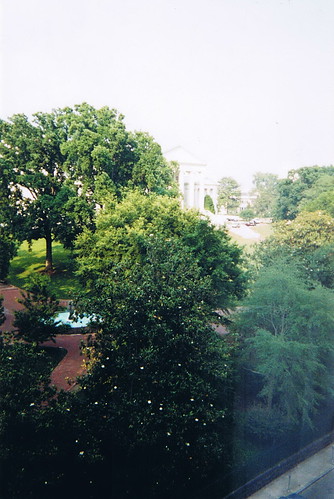

The white speckles on the tree in the foreground are magnolia blossoms. The actual capitol building is in the upper center.
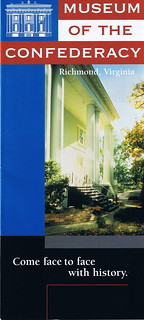
We were in Richmond to visit the Museum of the Confederacy. At the time, they were mounting the biggest exhibit assembled to date, of Robert E. Lee memorabilia. We knew nothing of this museum, in fact, the article where we noticed the exhibit called it an "unknown gem". Given the feelings provoked by the Civil War, a museum dedicated to the Confederacy could be a lightning rod for all sorts of ideas. As 'Northerners', we have our own feelings about this time in US history. Carole had done some research on the war and felt that Robert E. Lee's personal conflict was not as examined as it should be. She really wanted to see this exhibit, so we amended our travel route and added Richmond to the itinerary.

The exhibit was incredible. Lee was a much decorated and respected general when the war broke out. It's well-known that he chose to go with the Confederacy because Virginia, his home state, seceded from the union. It did not make him happy. He fought against people he considered friends. I remember seeing letters from Lee to friends where he talked about his anguish. I believe there were uniforms, weapons, paintings and Lee's death mask. We came away from the exhibit with a new-found appreciation of just how much the war took a toll on Lee personally. And we found the museum to be simply a repository for items from that conflict. They don't really get into the whys or the ramifications of the war. They present what they have as 'this is what this is'. It really is a gem of a museum and I would urge you to go visit if you're close by.

It's a three block walk from the Virginia capitol building. The park surrounding the capitol is very nice. In 2001, I took this photo as we walked from our hotel to the museum.
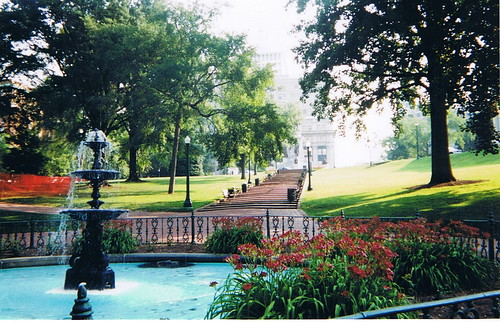

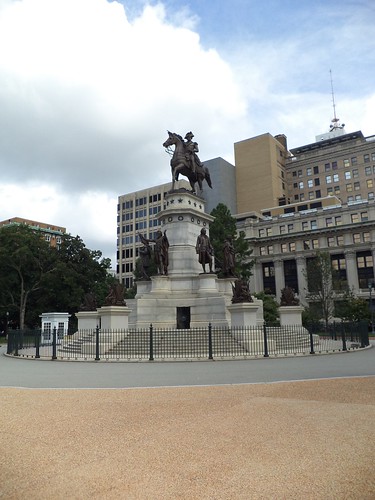
The steps lead to a statue of George Washington. In 2013, the fountain is still there.
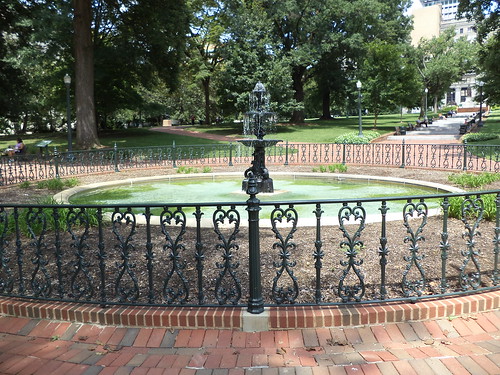

The steps still lead to a statue of George Washington.

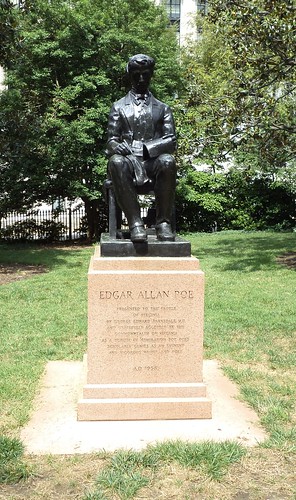
There's a small statue of Poe sitting off to the side. I don't remember seeing this before.

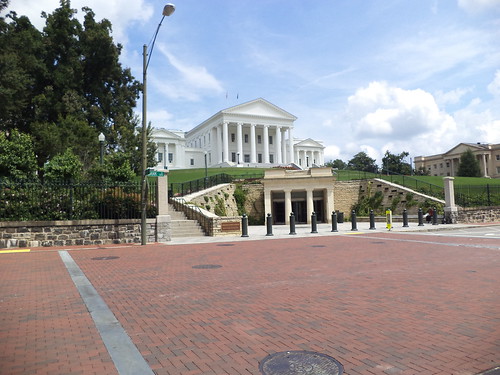
We did not take the capitol tour in 2001 as we were there for one specific reason. There is a new entry to the capitol building and it advertised tours. I didn't take the tour either as I was in downtown for two specific reasons; to see where Carole works and to visit the museum again.

I'm a big one on maps and certainly appreciate when an area is presented visually.
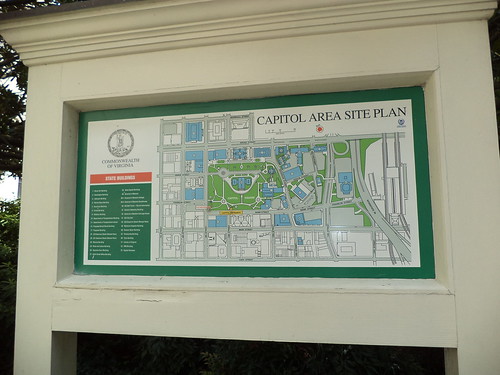

I entered the area of the capitol from the upper right of the map and walked to the lower left. Carole can see the building from her office area.

There is so much history here. I encountered this memorial plaque as I was walking to Carole's office.
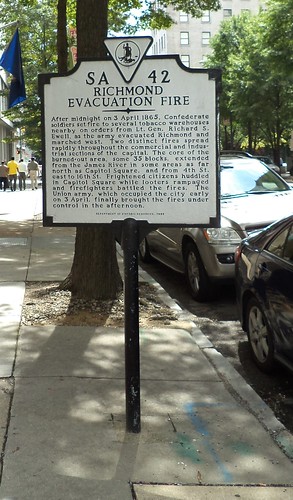

This talks about the fires set by Confederate soldiers in April of 1865 as the Union army closed in on the city. Carole mentioned that several of the signers of the Declaration of Independence, including George Washington and Thomas Jefferson, were meeting in Richmond at a time when the British army was approaching the city. Thanks to some fast thinking, the army was delayed just enough to get those men out of Richmond and to Charlottesville, 70 miles west of Richmond. Had they not been warned to leave, the Revolutionary War might have been a mere skirmish. It's easy to forget that part of Richmond's history as so much was tied up in the Civil War. To rectify that, Richmond developed the Richmond Liberty Trail.
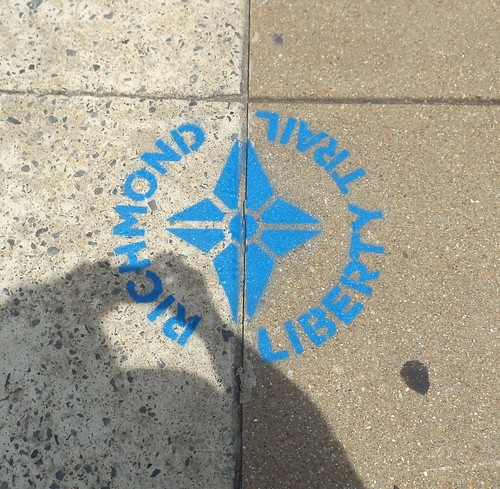

This is painted on the sidewalk. This is self-guided and goes all over downtown Richmond. There is no real beginning to the trail. I must have seen a half-dozen of these on the sidewalk in my walk. Further research indicates this trail overlaps with two other walking trails, both self-guided. It's so easy to forget that the US history here predates items with which I'm familiar.

I wanted to visit Cold Harbor Battlefield while I was there. In 2001, we visited Tredegar Iron Works, which is the 'official' starting location for Civil War tours in Richmond.


But, on Wednesday, when I set out, I copied one direction wrong and ended up in an area that didn't seem right. After driving around for an hour, I never did find the battlefield and felt that I could get myself horribly lost so, when I found I-95, I headed back to Carole's. It was only when I was looking through our 2001 trip that I found the battlefield map we'd picked up. I should have brought it along.
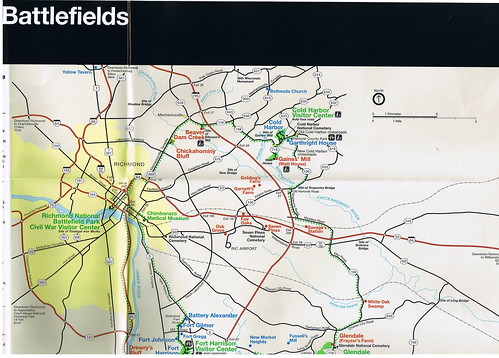

When you combine the history from Revolutionary War days with Civil War days, there is a lot to see. It appears Carole is going to be settled in this area for the foreseeable future, perhaps this is now her home. With enough visits, I can maybe get around to all these places. And the walking is good for me.

Beverage:  English Breakfast tea

Deb

Saturday, September 22, 2012

150 Years

On Monday, we, as a country, passed a milestone. I'm willing to bet not a lot of you noticed it. It was in the news but buried way down after all the coverage of this soggy mess we call the race for the presidency.

It was a sunny day, 150 years ago last Monday that the Union and Confederate armies met outside a place called Sharpsburg, Maryland. You might know it as Antietam. During this one-day battle, 23,000 men were either killed or wounded, the bloodiest day in U.S. history. Ironically, the 17th of September is also Constitution Day. The Civil War threatened to shake that constitution apart. The men who fought, lived and died here probably didn't know what significance the date was, and perhaps, at the time, very few others did.

In June of 2001, after Carole graduated from Wheaton North high school, the two of us rented a car and took a tour of various Civil War battlefields. Our first stop was Gettysburg. Our second stop was Antietam.


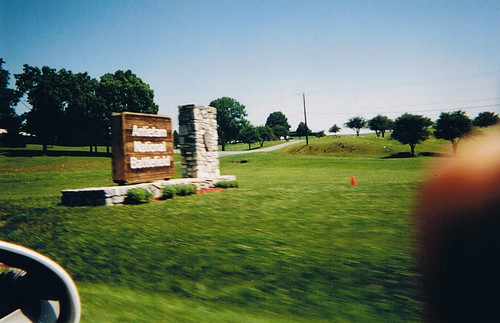
I remember the battlefield as being hard to get to, not like Gettysburg at all. I remember driving around curving roads and past the memorial cemetery, into a part of Sharpsburg which seemed to look, except for a highway, much like it must have looked in 1862.

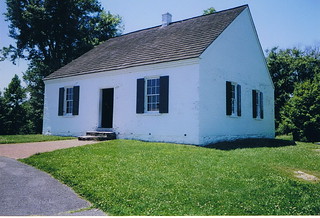
I don't remember the visitor center. I remember the asphalt road that took you into the battlefields, to the locations, such as Dunker Church, above. The road was one-way, the better to preserve the area. I don't remember going into the church, but I'm sure we must have.

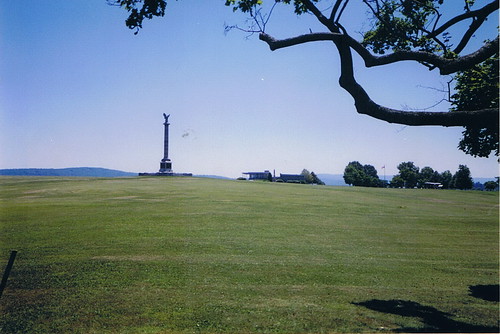
The drive circles through the park, which was, at the time we were there, two separate areas, joined by a thin strip of land.


This view looks back at the park buildings and the New York Monument.

There are many places to get out and look. Probably the biggest "attraction" if you will, is the sunken road or "bloody lane", as it came to be known. The Union attacked the Confederate, charging out of a cornfield and straight at the road. As this was June, the corn, which the park service dutifully plants in the same field every year, was only knee high. On that September day, it was about a month off harvest so it was over a head in height.

The Union attack came from the right. (The lane is not north south. It's on a diagonal from SE to NW.) This was, at the time of the battle, a two wheel rutted track used mainly by farmers. But it was sunken enough that men charging from the right would not be able to see how many were hunkered down in the road just waiting.

There is a brick observation tower at the south end of the road. It wasn't handicap accessible when we were there and it's about 3 stories tall. I remember climbing the inside, the metal stairs. It was warm inside the tower, but, when you got to the top, the view was worth the climb.

It's difficult, for me, to imagine the mindset of the soldier, either lying in wait in the lane or preparing to charge through head-high corn towards this little piece of ground. The Union soldiers burst through the corn. The Confederate men waited until they were within 4 feet, then stood up and fired. Whole squads were obliterated in minutes. In 4 hours of fighting, 5,000 men died here, just here. There were so many casualties in the road that, at the end of the battle, it was said you could walk from the tower to those trees in the distance without ever touching ground.

It's sobering to walk the road now. When we visited, there weren't many people at the battlefield. I would imagine September is the busy month and, over the weekend past, a reenactment of the battle was held over three days. Although it was afternoon when we got here, we had the chance to take our time, to walk about, to just be in the places where people fought and died.

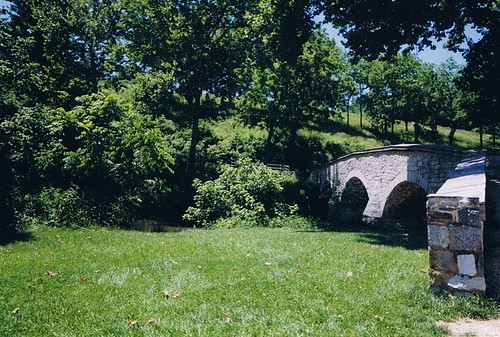
We ended the tour at Burnside Bridge. In reading and listening to the stories about the battle, I could not remember visiting the bridge. We had to; no tour would be complete without stopping there; but as much as I remember looking out over the battlefield from the tower, passing by Dunker church and pausing amongst the trees where Lee's camp was, I don't remember the bridge. In looking through our photos, here it is.


General Ambrose Burnside and his men spent all afternoon trying to go from the point the photo is taken, across the bridge and up the far hillside. The Georgia militia held them off until Burnside was reinforced and sheer numbers overwhelmed them. It is said the creek was red with blood. The bridge was named for Burnside's attack. We walked across it, hearing only the sound of Antietam Creek below us. It's a lovely bridge. 


The battle was, essentially, a stalemate. No ground was gained or lost. Lee retreated and General George McClelland chose not to purse him. That decision resulted in one of Lincoln's best quotes, written in a letter to McClelland. "My dear General McClelland, If you are not using the army, I should like to borrow it for a short while. Yours respectfully, A. Lincoln." But McClelland's inaction here was the final straw which resulted in his being fired by Lincoln. 

Alexander Gardner, one of Matthew Brady's employees, came to the battlefield two days after the fighting. His images are the ones we recall, the bodies in front of Dunker Church and still lying in the sunken road. It took four days to find and bury all the bodies, four days. 

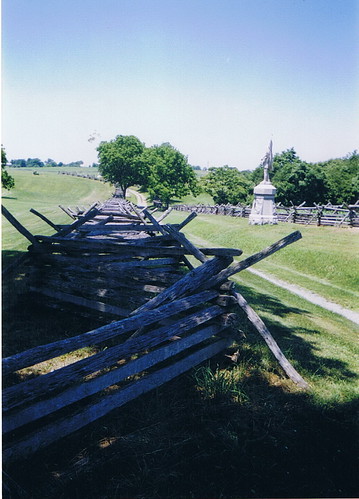
I liked Antietam better than Gettysburg. There are so many monuments to divisions, regiments, battalions and points of battle at Gettysburg that it can be hard to imagine what the men experienced. Antietam has its monuments, such as the one above, but they aren't all over. It's a beautiful place and beautifully preserved.

Beverage:  English Breakfast tea

Deb