Showing posts with label Gettysburg. Show all posts

Tuesday, November 19, 2013

150 Years

Today is the 150th anniversary of Abraham Lincoln's "Gettysburg Address". Two hundred and seventy-two words were all that was needed to consecrate the ground under which so many Union soldiers were buried.


Filmmaker Ken Burns, whose seminal series "The Civil War" not only defined the documentary genre, but also helped reexamine the causes of that war and how far we have or have not come from it, has added another project to his vast stable of projects. It's called "Learn the Address". On the web site, www.learntheaddress.org, you find the stated purpose of this project.

To celebrate the 150th anniversary of the Gettysburg Address, documentarian Ken Burns, along with numerous partners, has launched a national effort to encourage everyone in America to video record themselves reading or reciting the speech.The collection of recordings housed on this site will continue to grow as more and more people are inspired by the power of history and take the challenge to LEARN THE ADDRESS.

There are also a number of people shown reading or reciting the address. You can click on their portrait to listen and watch. I hope, eventually, the faces rotate from the current batch of public figures to include members of the general public, the "John Smiths" and "Mary Wilsons" of the country; every age and every ethnicity; reciting or reading this address.

I have a lot of things stuffed into my head. This morning I tried to remember to bring a couple boxes to the Jeep which need to be mailed. I started the Jeep and commenced scraping the windshield and then remembered that I'd told myself to remember the boxes. Some days, I fear what I had before is not what I have now. I also remember, back in college, two of my professors required memorization of texts studied in class. They said memorizing something then would stick with me for the rest of my life. I do remember the lines I memorized from "Rime of the Ancient Mariner" by Samuel Taylor Coleridge, but I don't remember all of the eulogy of Julius Caesar spoken by Marc Antony in "Julius Caesar" by Shakespeare. In case you don't know to what I'm referring, it's the "Friends, Romans, countrymen, lend me your ears. I come to bury Caesar, not to praise him," speech.

When I mentioned to my doctor that I feared something was awry with my memory, he said nothing is wrong. I'm just trying to remember way too much. He said that although those of us who went to college think of it as being the height of needing to remember things, that is not the case. As we age, there are more things we are tasked with remembering. While that keeps our brains from atrophying, if we don't have tricks to remember things, such an mnemonics, the reason we went to the grocery store is lost.

I think about the visit Carole and I made to Gettysburg. We went to the cemetery on our second day. It was a beautiful June morning.
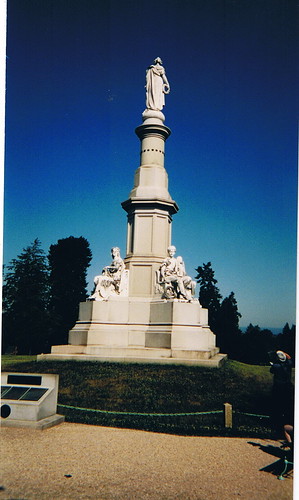

The Soldier's National Monument is at the center of the cemetery. This ground is quiet. It's like everyone who was there, and there were a number of people walking about, knew it was hallowed ground. The noise from the surrounding roads just seems dampened. This monument, it should be noted, is not at the location of the dais on which Lincoln spoke. That exact location has been the subject of discussion.

I've decided to try to memorize the address. We all learned "Four score and seven years ago, our fathers brought forth on this continent, a new nation; conceived in liberty and dedicated to the proposition that all men are created equal." Beyond that, we often quote the ending lines, "...that government of the people, by the people, and for the people shall not perish from this earth." In between are 224 words that need to be memorized.

I didn't realize, until reading up on Ken Burns' project, that there are five versions of the speech. They differ a bit in language but the differences are minor. I have decided to memorize what's called the "Bliss Copy". It is the version reprinted the most; the only copy signed and dated by Lincoln himself; and is version on the walls of the Lincoln Memorial.

I urge you to consider committing this to memory. Will it change the world? Possibly not. I have come to believe that government is not, "of the people, by the people and for the people".  Lincoln himself was a product of Republican behind closed doors deal making in order to get nominated for President. I think he was looking idealistically at what could happen once the war was over, in spite of his not being the President "of the people" in the South.

Yet, who knows. Maybe if we commit this to memory, 272 words will remind us that all people are created equal and that government is for us. It can't hurt. Plus, stretching one's mind to memorize something is a good way to keep it healthy.

Four score and seven years ago our fathers brought forth on this continent, a new nation, conceived in Liberty, and dedicated to the proposition that all men are created equal. 

Now we are engaged in a great civil war, testing whether that nation, or any nation so conceived and so dedicated, can long endure. We are met on a great battle-field of that war. We have come to dedicate a portion of that field, as a final resting place for those who here gave their lives that that nation might live. It is altogether fitting and proper that we should do this. 

But, in a larger sense, we can not dedicate -- we can not consecrate -- we can not hallow -- this ground. The brave men, living and dead, who struggled here, have consecrated it, far above our poor power to add or detract. 

The world will little note, nor long remember what we say here, but it can never forget what they did here. It is for us the living, rather, to be dedicated here to the unfinished work which they who fought here have thus far so nobly advanced. It is rather for us to be here dedicated to the great task remaining before us -- that from these honored dead we take increased devotion to that cause for which they gave the last full measure of devotion -- that we here highly resolve that these dead shall not have died in vain -- that this nation, under God, shall have a new birth of freedom -- and that government of the people, by the people, for the people, shall not perish from the earth. 

Abraham Lincoln
November 19, 1863
Beverage:  Darjeeling Tea

Deb

Wednesday, July 17, 2013

Ghostly Books

After a flurry of books about battlefield ghosts, I'm back to the stack of magazines. I'm so close to having that stack gone, finished, recycled, that one of my goals to read books has sort of fallen by the wayside. There might be a dozen magazines in the stack now. I didn't count last night when I finished yet another one and tossed it into the recycling bin.

But I thought I'd do a book review of the three books by Mark Nesbitt on battlefield ghosts that I read around the July 4th anniversary of the Battle of Gettysburg. The first review is of this one to the left. I ordered it from Just the Bookstore in Glen Ellyn and picked it up Friday after the Jeep was fixed so it would pass emissions testing. On Monday, I finished it. 

It's okay. It's a fairly quick read with chapters that are 3-4 pages in length. The battles he covers are arranged chronologically from 1861-1865. The problem with the book is that about three-quarters of the way through, it feels as if the author felt he had bitten off more than he really wanted to write about.

When the book starts, there is an excellent synopsis of the major battles of the Civil War. Detailed descriptions of these battles are for other books. He's concerned with where the armies were, where they moved during the particular battle and where the deadliest fighting occurred. I found his synopsis, at the beginning, to be very well done.

The problem, if you haven't guessed by now, is that Nesbitt seems to lose steam or desire for the concise descriptions of the battles that he starts with. In setting the stage for the ghost stories he's going to relate, it just seems as if he decided he was being too wordy before and he needed to pare down the descriptions. While I didn't read the book for a description of the battles, they way he presents the battles early in the war help put the ghost stories in context. 

Plus, he leaves out the Petersburg campaign entirely. I cannot believe he has no stories from the siege that produced "The Crater" and which saw a black regiment severely decimated by Southern troops. They took out their anger about the war on those soldiers, killing any black soldier they could find even those who attempted to surrender. You would think the trench warfare of this campaign would produce all sorts of stories. Sherman's March to the Sea is also curiously absent. The emotions, which still run raw, about this march and what Sherman did to the south would certainly have produced ghost stories. If there are any, Nesbitt doesn't include them.

There are stories from Chattenooga and Kentucky. We tend to forget that the Civil War was fought from Gettysburg to Mobile, from Charleston to Texas. Iowans were in Arkansas. Every battle produced casualties and while a detailed battlefield book is not what this purports to be, I was quite surprised that he left out two major events. 

The ghost stories related are of the usual kind. They weren't particularly scary. If you want to be scared, you need to read his Ghosts of Gettysburg series. I had high hopes for the Ghost Trails books because of the other series. Nesbitt was a ranger at Gettysburg National Battlefield and knows that area extremely well. It shows in the attention to detail of the stories he collects. Some of the stories in the Gettysburg book made me shiver. 

There's the bed and breakfast across the street from the house where General Lee had his headquarters. One chilly fall evening, the owner went to the wood pile to get an armload of wood. He picked up the wood and heard sounds that could only be described as cannon fire. They were coming from the far end of the open field behind the inn. As he looked across the field, he saw shadows form and start moving towards him. They took on the shape of men. This would be Union soldiers who were routed from their positions and fled back into and through Gettysburg. He attempted to step aside as he saw a soldier running towards him but the shade ran right through him. At this point, he dropped the wood and fled back inside. When he told his wife what had happened, she said she had been in the back office doing paperwork when she saw what looked like men running past the inn. She couldn't see any detail on them. They were all shadowed but it was quite clear they were running through the side yard. 

With the ghost stories in the ghost trail book, there isn't this attention to detail. More space is given over to Nesbitt's attempt to communicate with reported ghosts than with the actual reports from people of what they have experienced. He uses a digital tape recorder set on voice activation. He goes to a battleground and asks general questions to the air and hopes that he gets something in return. I don't find these kinds of stories as chilling as the stories of people having encounters they cannot explain. I can't believe there aren't stories out there.

The only story from the ghost trails book that gave me chills was the story of the Carter House in Franklin, Tennessee. Tod Carter fought for the Confederate Army and was in sight of his boyhood home when he was shot 9 times. His men carried him from the field of battle into his home where he died. The Carter farm is now a museum detailing the battle and life on the farm. 

One day, right before closing, a thin man in wool pants, scuffed shoes and a cotton shirt showed up at the museum and asked for a tour. The museum director took him around. She became increasingly irritated when this man would politely correct her on numerous aspects of the battle fought around the farm and on the lives of the family who lived there. They headed to the cellar where she was to give a presentation on how the family stayed in the cellar during the battle. The young man became agitated and said they weren't allowed in the cellar. She assured him that it was okay. She turned on the light to go down the stairs and he vanished in front of her. A week later, as she was going through family photos for an exhibit, she found a photo of the man she had given the tour to. It had been Tod. No wonder he knew about life on the farm. 

Nesbitt has changed the focus of the Ghosts of Gettysburg books just a bit. He looks at these stories with a somewhat skeptical eye. There is no doubt, to him, that something is going on in places where life was violently removed from so many. For himself, as much as for anyone else, he wants some sort of tangible proof in this, that what someone experiences is real. I remain skeptical of the tape recorded sounds. Poltergeist activity; the moving of items, slamming of doors, touching, shoving, etc; can be more solid proof, as is auditory sounds of battle when there is nothing visible. People report the smell of rotten eggs, a remnant of the sulfur that was used in ammunition, or the smell of smoke. Nesbitt reports people who visit The Wilderness battlefield often smell smoke. The woods caught on fire several times during the battle which lead to many deaths as men who were wounded and couldn't move were burned alive. 

He mentions that only 10% of paranormal encounters are with full specters as the guide had at the Carter house. A full 60% are of the poltergeist nature and the rest are auditory or olfactory. He's not very fond of the ghost "hunters" on television. He believes you don't hunt for ghosts. You just happen to be in the same space as them. They determine whether they will reveal themselves to you. And these "hunters" are looking for a full spectral manifestation, ignoring how most incidents occur. 

He's even less happy with people who show up in packs with their meters and infrared cameras. Controlled, almost scientific, investigations are what he's doing now, what he's reporting on now and he feels these packs of would-be investigators erode the credibility of those who are trying to solve the mystery of what people experience in these locations. He was polite but not charitable to the TV program he found himself involved with because they did not show all the prep work he and those he works with do prior to an investigation. The TV program was disappointed when they didn't get a ghost on film and only got noises even though that's the way most ghosts manifest. 

If you are interested in purported real-life ghost stories, pick up the Ghosts of Gettysburg series. You can get them as e-books now, if you read on one of those devices. The Ghost Trails book can be summed up thus, "Battlefields can have ghosts. If you visit one of the Civil War battlefields or a house or building that was associated with the Civil War, you have the potential to have an experience you can't logically explain." Beyond that, it's really not worth the money to buy. 

Beverage:  Yorkshire Gold tea

Deb

Wednesday, July 3, 2013

Ghosts of Gettysburg

It's said that a haunting is the residual effect of someone's life force being attached to a location. This could be some place they were very fond of or some place where life was removed forcibly or violently. It stands to reason then that the men who fought so passionately over a cause they believed in to their very core would remain on the fields where they fell.

War, in 1863, was hell. The minnie ball was a round projectile made of lead. When shot, it expanded and could fell a target at half a mile. One of the most deadly cannon munitions was called grape shot. Small iron balls were wrapped in a bag and tied, making the bag look like a bunch of grapes. Fired from close range, the bag disintegrated spewing the shot on a wide variety of targets.

Now days, a bullet into an arm is usually survivable. In the Civil War, if you were shot by a minnie ball, your arm below the point of impact was, essentially useless. Bones and bodies disintegrated upon contact with these munitions. If you didn't die, you still faced the medical care of the time, which was akin to a butcher slaughtering animals. There were no anesthetics so limbs to be amputated were simply hacked off at the point of impact. If you were shot in the torso or head, they merely gave you palliative care until your wounds killed you. It's no wonder a Civil War battlefield is haunted. The violent way men died would leave their spirits imprinted on the land.

I can't say, for certain, that I've experienced a haunting. Things have happened that I can't explain. If we believe we all have a spirit of some form, where that spirit goes is a subject of huge debate and speculation. If you were severed violently and against your wishes, from your spirit, what's not to think that the spirit would still reside in that place. Time appears to be more than just linear and what's not to say that an event such as the Battle of Gettysburg would imprint itself on time. We speak of the "fabric" of time and couldn't that fabric bear the images, impressions, thoughts and feelings of the thousands who found themselves against one another in farms, orchards, hills and fields?

It's been said that Gettysburg is the most haunted location in the US. I stumbled across this series of books when I was looking for information in preparation for our trip in 2001. At the time, there were five volumes. Six and seven have been released but I have not read them. If you are fond of stories that will send shivers down your spine, the stories contained in this series will do that.

Nesbitt's writing style is quite folksy. He has a history with the battlefield so he has some credibility with regards to the stories and events he relates. This endeavor, collecting ghost stories, proved to be quite lucrative and his company runs ghost tours of Gettysburg. I don't remember why Carole and I did not take one. I think it might have been the cost and when they were scheduled. Gettysburg was our first stop on our battlefield tour and we wanted to hit as many parks as possible in a week, as well a fit in a visit to the Museum of the Confederacy for their Robert E. Lee exhibit.

What we did, instead, was read all the books and then pick the locations we wanted to visit. I know she was hoping for a ghostly encounter. I was certain that, if we did meet a ghost, I would faint dead away and I really didn't want to find myself face-to-face with a spirit who might not be in the best of moods. There is a story in one of the books about 3 women from New York who were driving in the park late on a summer's evening, when the park is open late. They stopped by the Alabama monument, got out and walked over to look at it. It's a big slab of either granite or marble and it's tucked off the road against some trees where a contingent of Alabama men made an encampment. As they walked around the monument, they started to hear male voices. They couldn't make out what was being said. Then, slowly from the trees, a handful of soldiers emerged dressed like Confederate soldiers. They stopped and looked at the women and one of them said, in a low southern drawl, "You ought not to be here. I think you should leave." The women did just that.

We found that monument, in the dark of the battlefield the last day we were there. We didn't see anything. Little Round Top was empty, save for tourists looking over the peach orchard and the wheat field below. Often, visitors report of seeing campfires in both locations at night.

We went to the Devil's Den and wandered amongst the rocks. It was warm, I remember. The rocks are naturally reddish which absorbs the sun's heat. Even with hard packed gravel paths, you could feel that heat through your shoes.

We found ourselves at the Triangular Field.


Some of the fiercest fighting of the battle was here. The field is not very big. It's boarded by trees on two sides and was fronted by a low stacked stone wall. The Devil's Den, which is behind me in this photo, was held by the Union. Confederate sharpshooters hid behind the wall and in the trees and were a menace to anyone trying to take the area. The path visible above, will take you to other battlegrounds.

Because of the huge number of casualties here, this is supposedly one of the most haunted places around Gettysburg. In reading Nesbitt's book and in subsequent reading of ghost stories, it is said that cameras will suddenly die while walking in the field. This goes for still as well as video cameras. They resume working as if nothing is wrong once removed from the field. Confederate sharpshooters will be seen standing up from their positions behind the wall, turning and running down the field to the trees but blending in with the light and shadow before getting there. Men are seen at the perimeter of the field as well as bodies lying in the field. There are unexplained lights and mists at night.

I know you're waiting for me to say we saw something, but we didn't. The camera worked just fine and because it was a hot summer's day when we visited, we walked the path to the bottom, turned around and came back. Ghosts are not like performers. They don't show up on cue.

If you are interested in ghostly events at Gettysburg, I recommend these books. They aren't very big, less than 100 pages total, but unless you are a complete skeptic, they will send shivers up your spine. If you're of the "delicate" sort, read them between 10 a.m. and 3 p.m. so that, by the time you are ready for bed, the image of the statue of a young boy turning and facing people is out of your head.

Beverage:  Water

Deb

150 Years

Gettysburg, was a quiet middle southern Pennsylvania town whose only claim to fame, at it were, was the Lutheran Seminary, founded in 1832, which has become Gettysburg College. There wasn't anything to distinguish this place from countless other places in the United States, even during the early years of the Civil War. We all know that completely changed at the end of June in 1863.

Briefly, General Robert E. Lee decides to take the war to the Union. He'd just won at Chancellorsville, Virginia, although he'd lost Stonewall Jackson in the fight. He felt, if he took war north, where people weren't experiencing it, beat the Union army on their own soil, they would sue for peace to prevent this awful thing from happening in their land.

Lee moved his army north and was in Chambersburg, Pennsylvania on June 28th when he received word that the Army of the Potomac was heading towards him. The story goes that Confederate soldiers, desperate for shoes, were spotted breaking into a cobbler's store in downtown Gettysburg. This is probably a fallacy. What is known is that the first real shots of a battle that would consume 3 days were fired at 7:30 a.m. on July 1st.


We think of the southern forces as attacking from the south but they were north and west of the town and this is where the battle began. The red line marks the Confederate travels. The blue line marks the Union travels. There is no right or wrong way to tour the battlefield, but, when Carole and I visited in 2001, we did things chronologically.

Monuments are everywhere. Every state that provided troops to either army has a monument where they camped or where they died.


This monument, unveiled by Franklin Roosevelt on the 75th anniversary of the battle, is north of town, near the site of the first shots being fired. There were, at the time of dedication, a few veterans of that war still alive.

Pennsylvania has the biggest and, it could be argued, most ostentatious monument on the battlefield.


You used to be able to climb stairs in each corner of the monument to have a wide view over the section of battlefield where Pickett's Charge was. This is considered the 'high water mark' of the Confederacy, the farthest north they ever got. The stairs are closed now as it's too dangerous to climb them.


This is the monument in the center of the Gettysburg Civil War cemetery. This was not here when Lincoln gave his address on a blustry November day.
We are met on a great battlefield of that war. We have come to dedicate a portion of it, as a final resting place for those who died here, that the nation might live. This we may, in all propriety do. But, in a larger sense, we can not dedicate -- we can not consecrate -- we can not hallow, this ground -- The brave men, living and dead, who struggled here, have hallowed it, far above our poor power to add or detract. The world will little note, nor long remember what we say here; while it can never forget what they did here.
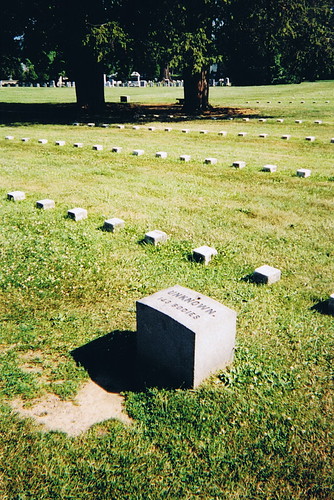
I've been in a lot of cemeteries in my life. None seemed quite so somber as this one. Even the traffic passing on a nearby highway seemed muted. 

This is the 150th anniversary of that conflict. It's a conflict we have never resolved. The defeat of the Confederacy preserved a nation. We are stronger together than we would have been had we split apart. But the echos of what each side fought for still ring through us.

Gettysburg is alive, today and through this coming weekend, with reenactors and the public. It doesn't seem right to call this a "celebration". What are we celebrating, exactly? A war that tore families and communities and a country apart? It's rather a remembrance, an anniversary.
It is rather for us, the living, we here be dedicated to the great task remaining before us -- that, from these honored dead we take increased devotion to that cause for which they here, gave the last full measure of devotion -- that we here highly resolve these dead shall not have died in vain; that the nation, shall have a new birth of freedom, and that government of the people by the people for the people, shall not perish from the earth. 
Walking amongst the memorials and the monuments, driving the paths that the armies marched, stopping where they camped and standing overlooking what they saw is a sobering experience. It's not a place to whoop and holler. I felt overcome with reverence every place we walked, every place we stopped and stood and read the plaques and took photos.


I didn't have family, to the best I can determine, in this war. We were in the US at the time, living in Iowa, but no one went off to war. Hence, I'm a bit detached from this place. There is not an ancestor with ties to this ground. But there is a tie we all share. Of all places in this country, three of them stand out to me as anything that could be considered shrines; the 9/11 memorial in New York, the Arizona Memorial in Hawaii and Gettysburg National Battlefield. Each place represents freedom.

It was accident or fate that brought two armies here. Independence Day was little remembered on July 4, 1863. It rained. It poured on Confederate and Union armies alike. It took 3 days to bury the dead and many more months before the wounded survivors could leave this place. Yet, it was this small town, nondescript, that gave us the country and the freedom we guard jealously to face future assaults. If you have a "bucket list", Gettysburg needs to be on it. You can't help but think about what transpired. You can't help but be moved. Will it change you? No, possibly not, but every American should, in their lifetime, stand amongst the monuments and think about what these men fought for.
Now we are engaged in a great civil war, testing whether that nation, or any nation so conceived, and so dedicated, can long endure.
We have endured Mr. Lincoln. 

Beverage:  Yorkshire Gold tea

Deb

Thursday, September 27, 2012

Still Hanging On

That's kind of how I'm feeling right now. I'm still hanging on. I'll blog on that this weekend. Right now, let's have a real post.

As I was going through the photos of the Civil War trip, I ran across a couple that struck me.

I believe this was at the top of the observation tower at the southeast side of Gettysburg. From here, you can look north, east and west over most of the battlefield. It's a rather tall tower and it's very open. As you know, I'm afraid of heights so I stood at the bottom of this looking up and contemplating whether my Civil War experience would be diminished if I didn't climb the tower. The steps were rather wide and there were many more people here than we would experience at any other battlefield on the trip. I decided that I would always kick myself for not climbing so up I went. I had to stop at least twice, that I remember, force the fear down, and continue on. "Look where you're going, not to the side, up or down," I remember telling myself that. This was my Uncle Moe's advice when paralyzing fear gripped me as we walked to the open 2nd floor of the Iowa capitol building in Des Moines. It doesn't always help but it can get me through some of the height issues. I had her photograph me at the top to prove, mostly to myself, that I did get to the top.


This next one was taken inside our hotel room at Gettysburg. My daughter has often made fun of my penchant for documenting the hotel where we stayed. I'm not exactly sure why I do it other than I take photos for documentary purposes. She's the artistic one. Sometimes, mine come out artistic but most of the time, it's a record of what I saw and where I was.


A couple of things struck me in looking at these photos. First of all, I still have that Charleston tee shirt and it still fits. I'm not the same size as I was in that photo. I'd like to say smaller but no. I also don't die my hair dark brown anymore. I've given that up. But the shirt was big back then and it's just the right size now. It's still in very good condition too, witness to my having probably more tee shirts than I really need. 

The next thing is in the bottom photo. See that lime green container on the bed? That's a lunch bag and I still have it and still use it. I drop an cold pack in the bottom and it does a great job of keeping my lunch cold. I have a bigger one that I use if I want to bring a plate with me. The green one doesn't hold a plate very well. It will be adequate if I tip the plate at an angle but that's often not feasible based on the containers of food I'm bringing. 

I look at other items in the photos. The visor, the shorts and tennis shoes are long gone. I don't know about the socks. Carole's sweat pants and top and the backpack are, I think, gone too, although she could have them and I wouldn't notice. It's just interesting to me what stands the test of time, what we hang on to, and what is gone. I look at further photos in this group and there's a Hawaiian shirt that I still have. Does Carole have that red shirt or is that gone? We are such a consumer society. So much landfill space is taken up with tee shirts and shorts that don't fit or are out of style now. It's one thing if they are falling apart. It's another to just get rid of them because they are last year's style. 

I'll wear the shirt and use the lunch box until they actually fall apart. They have made it at least 11 years on. Here's to another 11 years. 

Beverage:  Water

Deb

Saturday, September 22, 2012

150 Years

On Monday, we, as a country, passed a milestone. I'm willing to bet not a lot of you noticed it. It was in the news but buried way down after all the coverage of this soggy mess we call the race for the presidency.

It was a sunny day, 150 years ago last Monday that the Union and Confederate armies met outside a place called Sharpsburg, Maryland. You might know it as Antietam. During this one-day battle, 23,000 men were either killed or wounded, the bloodiest day in U.S. history. Ironically, the 17th of September is also Constitution Day. The Civil War threatened to shake that constitution apart. The men who fought, lived and died here probably didn't know what significance the date was, and perhaps, at the time, very few others did.

In June of 2001, after Carole graduated from Wheaton North high school, the two of us rented a car and took a tour of various Civil War battlefields. Our first stop was Gettysburg. Our second stop was Antietam.


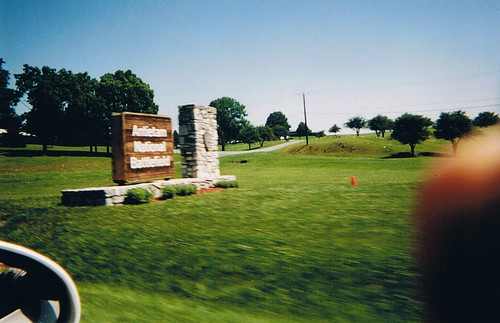
I remember the battlefield as being hard to get to, not like Gettysburg at all. I remember driving around curving roads and past the memorial cemetery, into a part of Sharpsburg which seemed to look, except for a highway, much like it must have looked in 1862.

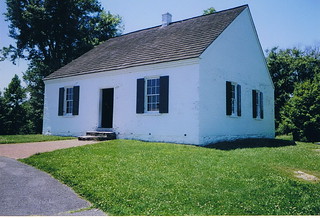
I don't remember the visitor center. I remember the asphalt road that took you into the battlefields, to the locations, such as Dunker Church, above. The road was one-way, the better to preserve the area. I don't remember going into the church, but I'm sure we must have.

The drive circles through the park, which was, at the time we were there, two separate areas, joined by a thin strip of land.


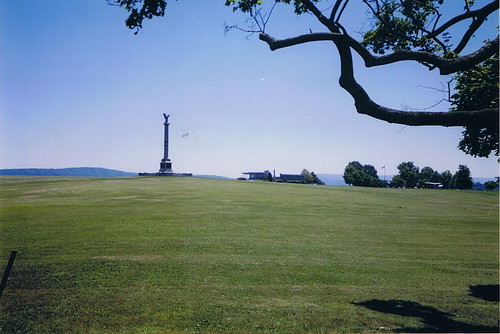
This view looks back at the park buildings and the New York Monument.

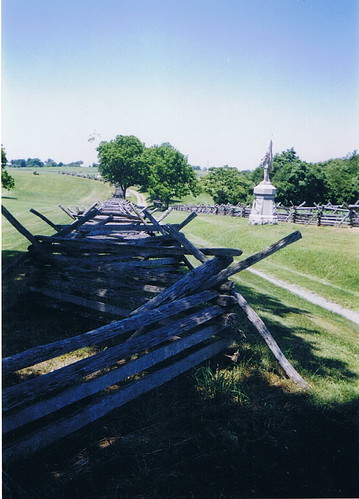
There are many places to get out and look. Probably the biggest "attraction" if you will, is the sunken road or "bloody lane", as it came to be known. The Union attacked the Confederate, charging out of a cornfield and straight at the road. As this was June, the corn, which the park service dutifully plants in the same field every year, was only knee high. On that September day, it was about a month off harvest so it was over a head in height.

The Union attack came from the right. (The lane is not north south. It's on a diagonal from SE to NW.) This was, at the time of the battle, a two wheel rutted track used mainly by farmers. But it was sunken enough that men charging from the right would not be able to see how many were hunkered down in the road just waiting.

There is a brick observation tower at the south end of the road. It wasn't handicap accessible when we were there and it's about 3 stories tall. I remember climbing the inside, the metal stairs. It was warm inside the tower, but, when you got to the top, the view was worth the climb.

It's difficult, for me, to imagine the mindset of the soldier, either lying in wait in the lane or preparing to charge through head-high corn towards this little piece of ground. The Union soldiers burst through the corn. The Confederate men waited until they were within 4 feet, then stood up and fired. Whole squads were obliterated in minutes. In 4 hours of fighting, 5,000 men died here, just here. There were so many casualties in the road that, at the end of the battle, it was said you could walk from the tower to those trees in the distance without ever touching ground.

It's sobering to walk the road now. When we visited, there weren't many people at the battlefield. I would imagine September is the busy month and, over the weekend past, a reenactment of the battle was held over three days. Although it was afternoon when we got here, we had the chance to take our time, to walk about, to just be in the places where people fought and died.

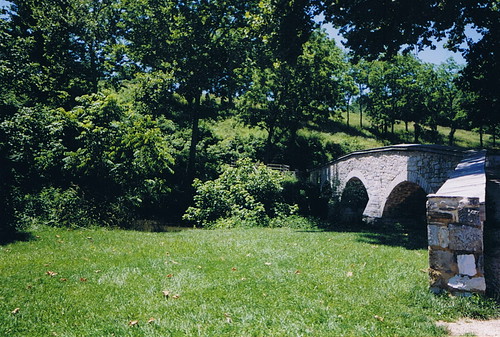
We ended the tour at Burnside Bridge. In reading and listening to the stories about the battle, I could not remember visiting the bridge. We had to; no tour would be complete without stopping there; but as much as I remember looking out over the battlefield from the tower, passing by Dunker church and pausing amongst the trees where Lee's camp was, I don't remember the bridge. In looking through our photos, here it is.


General Ambrose Burnside and his men spent all afternoon trying to go from the point the photo is taken, across the bridge and up the far hillside. The Georgia militia held them off until Burnside was reinforced and sheer numbers overwhelmed them. It is said the creek was red with blood. The bridge was named for Burnside's attack. We walked across it, hearing only the sound of Antietam Creek below us. It's a lovely bridge. 


The battle was, essentially, a stalemate. No ground was gained or lost. Lee retreated and General George McClelland chose not to purse him. That decision resulted in one of Lincoln's best quotes, written in a letter to McClelland. "My dear General McClelland, If you are not using the army, I should like to borrow it for a short while. Yours respectfully, A. Lincoln." But McClelland's inaction here was the final straw which resulted in his being fired by Lincoln. 

Alexander Gardner, one of Matthew Brady's employees, came to the battlefield two days after the fighting. His images are the ones we recall, the bodies in front of Dunker Church and still lying in the sunken road. It took four days to find and bury all the bodies, four days. 

I liked Antietam better than Gettysburg. There are so many monuments to divisions, regiments, battalions and points of battle at Gettysburg that it can be hard to imagine what the men experienced. Antietam has its monuments, such as the one above, but they aren't all over. It's a beautiful place and beautifully preserved.

Beverage:  English Breakfast tea

Deb

Thursday, July 2, 2009

Not on a bet.

I would imagine you have all heard the news. It's plastered all over my Yahoo news feed today.

Sears Tower unveils 103rd floor glass balconies

The full article is here.

I just want it made perfectly clear; nope, no way, nada, nix.

But why, you ask?

Simple, says I. I'm afraid of heights.

I've always been that way.

The first time I became aware of it, my family and I went to visit my cousins who lived in Des Moines, Iowa. I don't remember what year it was but part of the visit included a trip to tour the state capital building. I remember running into the building and seeing, on the first floor, a large circle in the floor which looked down into some room with chairs and desks. There was a vague feeling of uneasiness but I passed it off as excitement.

Looking up, there was another hole in the second floor and you could look straight up to the dome. It was, if memory serves me correctly, a beautifully decorated interior with lots of marble and statues and frescos on the walls. We looked about the first floor, what was open to the public, turned and hastened up to the second floor. I remember standing on the landing between the first and second floors, looking up at what my memory thinks were WPA paintings and being totally unable to go any farther. I can remember the fear, the paralyzing fear, that gripped me. I was scared to have to look down through that hole in the floor and just the thought was enough to prevent my legs from moving.

I've always been interested in art so I pretended to be studying the walls. My mother ordered me to come up the stairs. My dad made fun of me, once he realized I was scared to move. My cousins and siblings thought me weird. I felt humiliated and totally confused about this. I'd jumped from the hay mow to the basement of the barn through the hay chute. I'd jumped from the top of the hay stacks to the floor. I'd jumped out of trees. I'd sat on the sill of my second floor bedroom window with my feet dangling on the side of the house. Why was I so scared?

My uncle Moe came back down the stairs and put a big arm around me. In a jovial tone of voice designed to help and make me feel not so awkward, he told me this was a normal feeling. "You're scared of heights. It happens. The trick is to not let it paralyze you." He told me to keep my head straight and don't look below my nose. "So, you'll have to figure out where you can stand that lets you look at that hole in the second floor but not in a way to tilt your head down." I could look up but I couldn't look down.

I still can't.

Carole and I went to Gettysburg for her graduation from high school trip. There is a metal tower some 65' in the air at the border between the battlefield and General Eisenhower's farm. The winding staircase is wide enough for four people to walk abreast. I had to walk up two or three twists and stop. Carole said I didn't have to go to the top, but I knew I had to. I had to walk in the middle of the staircase and look only at the next set of stairs. But, I did it. I climbed to the top of the tower. Coming down wasn't hard.

In the former Marshall Field's flagship store on State Street in Chicago, the east side of the store has an open atrium. You take escalators anchored at each end but open to the atrium between the levels. I hate it. As long as I can stand in the center of the escalator, I can do it. The north side of the store has open holes in the floor where you can look from floor 7 to the main floor. I'm told it's an interesting view. I've never seen it.

And I'm told the view from the top of the John Hancock Center is gorgeous, particularly at night. I'm told it's the best view of Chicago, topping the view from the Sears Tower. I've never been up there. Carole and I spent one drizzly day in March of 2001 wandering around the area near the Hancock building. I had coupons for money off the trip to the 95th floor. But every time we got into the building, I could not, could not get into the elevator to go to the floor where you purchased your tickets for the observation deck.

But I love to fly and I always get a window seat.

So, when you come to Chicago, I'll be happy to take you around, but if you want to go to the Sears observation deck, you're on your own.

Beverage: English Teatime

Deb