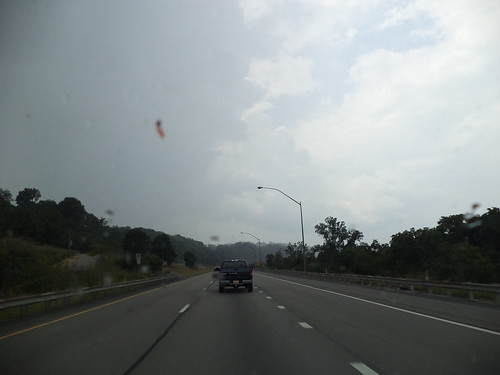
I've been watching the odometer creep into the "need an oil change" territory. I've got the potential for a job in the city so I decided to wait for that to materialize or not and then schedule an appointment to have the oil change done and the Jeep winterized. There should be a phone call today or tomorrow about the job so I would be able to schedule this soon.
In the meantime, I headed out into the field on an unrelated job and, well, let's just say things took a turn for the bizarre.
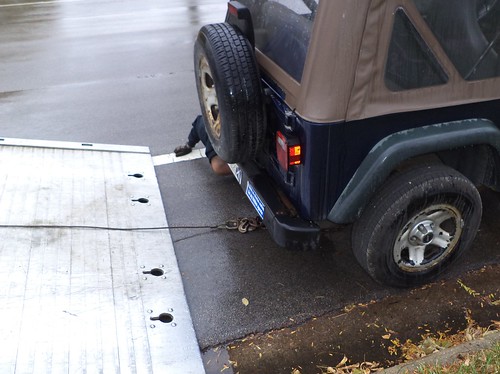
Yes, I am getting a tow.
I was parked on an incline. I set the parking brake and turned the wheels. I did what I needed to do and came back to the car. When I went to take off the parking brake, I had to push the brake pedal almost all the way to the floor. It wasn't like that when I stopped the car. Thinking something was odd, I drove up and over the rise to the flat and started pumping the brakes. Each time, I could stop but I had to depress the pedal almost to the floor. This worried me. Then, the brake light came on. Double worry.
I headed to the next stop and set up the next machine. As I was walking back to the Jeep, I noticed a very fast drip from under the car. I'm thinking fluid dripping is not normal. It wasn't oil, but there was a distinct petroleum smell. I had just filled the Jeep with gas but it was not gas. I know both smells of leaking oil and leaking gas. Could it be brake fluid?
I headed to the next stop and set up another machine. The drip was still going. I could stop, if I knew that I had to and could plan for that stop. But, if I was, say, cut off in traffic, there was no way I would be able to stop the Jeep. Worry set in. I called my boss and he came immediately to help with the job I was doing. I called my mechanic who said it sounded like a brake line had failed. So, I spent Wednesday afternoon waiting on a tow to my mechanic and then renting a car.
There are so many, many ways this could be worse. This could have happened on vacation. My mechanic gave the Jeep a complete check before I left on vacation. He looked over his report from early August and, at that time, everything was fine. But it's been 2.5 months since then and, given the age of the Jeep, stuff will fail. It was rainy but warm. It could have been a blizzard or sleet or 100 degrees in the shade with no breeze. They will get to the Jeep today and I'll only have the rental for one day. I have towing and, possibly, rental car allowance on my car insurance so I'll pay for everything and then, hopefully, get reimbursed. And it's the end of the month, payday, so this won't break the bank.
In years past, this probably would have depressed me for the whole of November. I'm in a much better place now so all I could think of, as I waiting for the tow truck, was this ditty, sung to the tune of "Bringing in the Sheaves".
Waiting for a tow.
Waiting for a tow.
We shall all be Facebooking,
Waiting for a tow.
Beverage: Yorkshire Gold Tea
Deb
Thursday, October 31, 2013
Sing With Me Now
Labels:
car repairs,
finances,
folk music,
humor,
Jeep,
work
Saturday, October 26, 2013
Rollin' Home
Thursday, August 22nd, I headed home from Virginia. It had been a lovely visit. I made the decision to go a different route back because of all the construction I had encountered in Ohio.
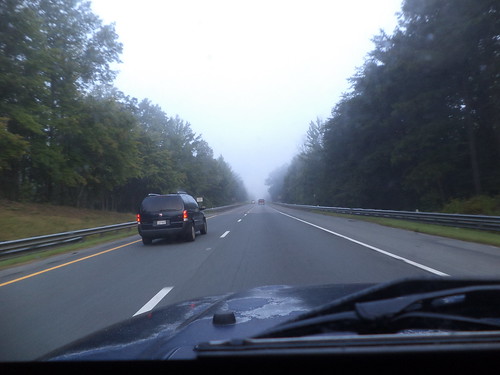
The morning was foggy.
I love driving in the fog, as long as I either know the road or, in this case, it was Interstate and I could be fairly certain of the highway. The fog only lasted an hour.
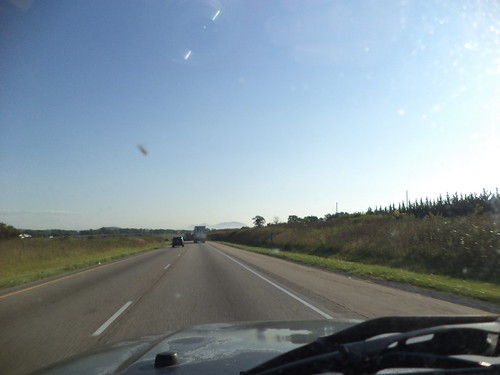
The morning was impossibly beautiful. The above photo was taken on I-64 west of Charlottesville. I hadn't seen this scenery the previous week because it was dark.
At the intersection of I-64 and I-81, I went right, north.
I drove north to almost the Pennsylvania border, meeting I-70 in Maryland, and turned left, to head west.
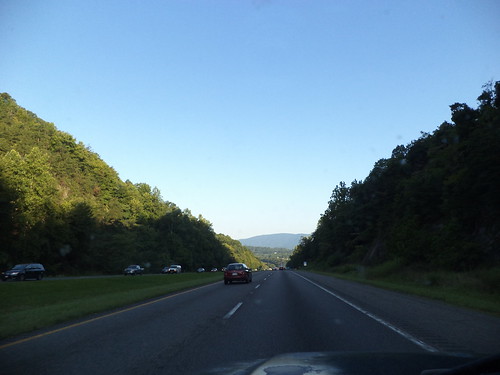
Here's where I met the mountains. I've driven this section before, back in 2011. Some of the scenery seemed familiar but it's still new. I-70 gave way to I-68 and I approached this cut through the mountains. This was familiar.
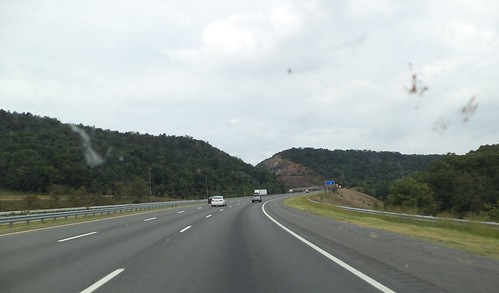
I noticed on the way out that there just weren't very many bug splats on the window. There were more on the way home, but I remember years of travel where you'd use the windshield wipers and the sprayer in an effort to get the bugs off the windows. Are there less bugs? Did I happen to travel during a time when bugs aren't plentiful? Or was my travel through a bugless area?
I-68 is designated the "National Freeway" and passes through some beautiful scenery in western Maryland. Notice I'm in the right lane. It was this drive where I really encountered the slowness of the Jeep. Try as I might, I couldn't build up enough steam to sustain even 60 miles per hour. My speed dropped to around 50 when I would finally clear the top of these mountains.
The morning was foggy.
I love driving in the fog, as long as I either know the road or, in this case, it was Interstate and I could be fairly certain of the highway. The fog only lasted an hour.
The morning was impossibly beautiful. The above photo was taken on I-64 west of Charlottesville. I hadn't seen this scenery the previous week because it was dark.
At the intersection of I-64 and I-81, I went right, north.
I drove north to almost the Pennsylvania border, meeting I-70 in Maryland, and turned left, to head west.
Here's where I met the mountains. I've driven this section before, back in 2011. Some of the scenery seemed familiar but it's still new. I-70 gave way to I-68 and I approached this cut through the mountains. This was familiar.
I noticed on the way out that there just weren't very many bug splats on the window. There were more on the way home, but I remember years of travel where you'd use the windshield wipers and the sprayer in an effort to get the bugs off the windows. Are there less bugs? Did I happen to travel during a time when bugs aren't plentiful? Or was my travel through a bugless area?
I-68 is designated the "National Freeway" and passes through some beautiful scenery in western Maryland. Notice I'm in the right lane. It was this drive where I really encountered the slowness of the Jeep. Try as I might, I couldn't build up enough steam to sustain even 60 miles per hour. My speed dropped to around 50 when I would finally clear the top of these mountains.
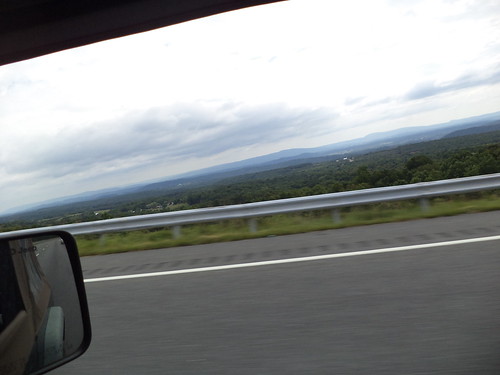
This photo is a good example of the "Blue Ridge Mountains". Notice the difference in color. The highest peak I cleared topped out at over 2800 feet. This is the time you want someone else with you so someone could take a photo of the nice sign they put up letting you know that, yes, your ears have popped because you're over 2600 feet.
Here I am in West Virginia.
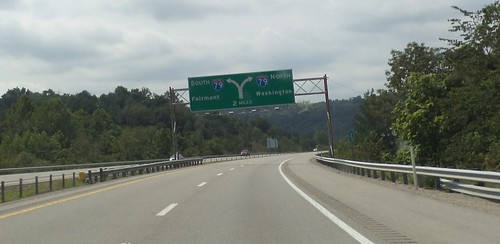
I met up with I-79 and headed right, to the north, to Pennsylvania.
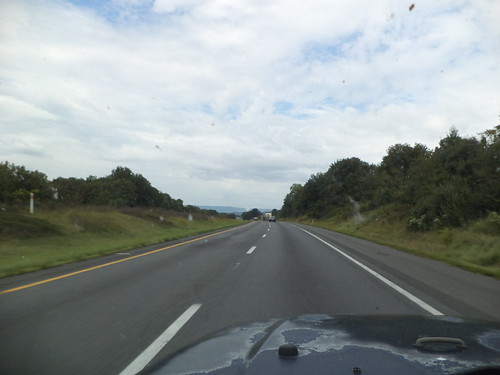
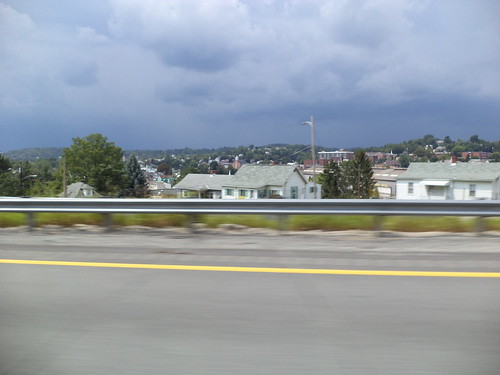
Western Pennsylvania still contains similar mountains. I knew, from checking the weather, that I could be driving into rain. Although the overcast weather in Maryland and West Virginia, kept the temperatures cool, once I got into Pennsylvania, the temperature went up, even in the mountains, by about 15 degrees. And there, like a wall, were the rain clouds.
It turned out, however, that I drove around the rain for at least an hour.
North of Pittsburgh, we met, but it wasn't much to speak of, a brief shower moving from left to right and I drove out of it as quickly as I drove into it.
It didn't cool off the air at all.
I picked up good old familiar Interstate 80, turned left and headed west. Oh hey! I know this intersection.
I waved in the direction of April and Perry's. Next time, I hope my trip allows me to see all the people I know around Youngstown.
As I headed west, I could see the rain south and west of me. It seemed like all the hype about "heavy" rain or even any kind of rain wasn't going to happen.
But it was in western Indiana when I finally met the rain which actually cooled things off. I love driving in rain. I love the swoosh of the wipers and the rattle of the rain on the roof. In the summer, I love the change of smells from hot pavement to steamy pavement to cool, wet pavement. I love the look of the land in the rain.
Beyond this, it grew too dark to take photos and I could feel how close home was. When I pulled in the drive, 16 hours after leaving Richmond, I was exhausted, but nothing is quite so wonderful as knowing you're home.
Would I go that route again? It's all Interstate, unlike the route out. I'm not sure. Knowing that there is major construction in Dayton and how poorly marked the intersection of the two routes was where I had to leave the Interstate and pick up the US Highway, I'm not inclined to want to go that way. But the way out was 2 hours less time and that's a strong consideration in travel. There are a number of ways to get from here to there and back again. If this becomes a yearly event, I'll have a chance to experience them all.
Beverage: Lady Gray Tea
Deb
Labels:
Appalachian Mountains,
April,
driving,
fog,
home,
Indiana,
Interstate,
Jeep,
Maryland,
mountains,
Ohio,
Pennsylvania,
Perry,
photography,
rain,
sunrise,
travel,
vacation,
Virginia,
West Virginia
A Golden Lady
Many years ago, at the Printer's Row Book Fair, I stumbled upon this reproduction print.
The scan doesn't cover the sides completely but you see most of this. This print is of a photo of the Statue of the Republic and Peristyle which was in the Court of Honor at the World's Columbian Exposition held in Chicago beginning in May 1893, and running to October 1893. The fair was designed to honor Christopher Columbus' discovery of the Americas in 1492. Although the area where the fair was located was dedicated in 1892, due to construction and other issues, it wasn't opened until 1893.
The fair is known for things like the forerunner to the zipper closure, Juicy Fruit Gum, Pabst Blue Ribbon Beer and spray painting. Frederick Law Olmstead, America's premier landscape architect at the time, designed the 650 acres which encompassed the park. Over 700,000 people attended the fair and marveled at things like the fully electric kitchen and the world's first Ferris Wheel. That particular ride was moved north to Lincoln Park and then to the St. Louis World's Fair. After that fair, it was destroyed.
Chicago received benefits such as the land where the fair was becoming Jackson Park. The Museum of Science and Industry, one of the crown jewels of Chicago museums was, originally, The Palace of Fine Arts. The Museum gives guided tours of its building detailing its original role in the fair and the innovations which came from this event.
One of the most visible remnants of the fair can be found at Hayes Drive. I have long admired this statue.
If you notice, it bears a startling similarity to the statue at the exposition. It's supposed to. Daniel Chester French, an extremely prolific American sculptor, designed and built the original statue. The original statue at the exposition was 65 feet tall and was at the eastern edge of the fair, facing west. The current statue faces east. A pier, located behind the original, was a point of entry for many visitors. They "rode" to the fair entry, located under the arch in the top photo, on a moving sidewalk, the first of its kind. Most of the buildings at the fair were constructed with plywood and a building material called "staff", made of plaster of paris and hemp, insulated with straw. The walls were then whitewashed which gave the exposition the nickname "The White City". When the exposition was over, the buildings were torched. It was a great event in Chicago and people came from all over to watch the city within a city burn to the ground. The statue was dismantled.
The statue was supposed to represent the resilience and strength of a country that had come through a Civil War. Plus, immigrants from all over the world, were flocking to the open arms of the US. Six years previous to the fair, the Statue of Liberty had been dedicated in New York. You can see the influence of that statue in French's design.
In May of 1918, on the 40th anniversary of the fair and the 100th anniversary of Illinois becoming a state, this statue was unveiled. It's 24 feet high, of gilded bronze, and stands on a specially built pedestal. French assisted Henry Bacon in reproducing his original design. French and Bacon went on to design the Lincoln Memorial.
When I have to come to the south side of Chicago on business, I make sure my drive takes me by this statue. Chicago has a huge number of public statuary but this is my favorite. Even on overcast days, she gleams. I'm not sure what they do to keep her gilded but, whatever it is, it's a wonderful job. If you'd like to read more about this statue, go to this link. Another extremely good source of information about the exposition is Erik Larson's book, Devil in the White City. It's an extremely well-written and deeply researched story built around the fair.
Some day, I hope to redo the room where the litter boxes are and this is one of the pieces I want to frame and put on the wall. Some day.
Beverage: Lady Gray tea
Deb
The scan doesn't cover the sides completely but you see most of this. This print is of a photo of the Statue of the Republic and Peristyle which was in the Court of Honor at the World's Columbian Exposition held in Chicago beginning in May 1893, and running to October 1893. The fair was designed to honor Christopher Columbus' discovery of the Americas in 1492. Although the area where the fair was located was dedicated in 1892, due to construction and other issues, it wasn't opened until 1893.
The fair is known for things like the forerunner to the zipper closure, Juicy Fruit Gum, Pabst Blue Ribbon Beer and spray painting. Frederick Law Olmstead, America's premier landscape architect at the time, designed the 650 acres which encompassed the park. Over 700,000 people attended the fair and marveled at things like the fully electric kitchen and the world's first Ferris Wheel. That particular ride was moved north to Lincoln Park and then to the St. Louis World's Fair. After that fair, it was destroyed.
Chicago received benefits such as the land where the fair was becoming Jackson Park. The Museum of Science and Industry, one of the crown jewels of Chicago museums was, originally, The Palace of Fine Arts. The Museum gives guided tours of its building detailing its original role in the fair and the innovations which came from this event.
One of the most visible remnants of the fair can be found at Hayes Drive. I have long admired this statue.
If you notice, it bears a startling similarity to the statue at the exposition. It's supposed to. Daniel Chester French, an extremely prolific American sculptor, designed and built the original statue. The original statue at the exposition was 65 feet tall and was at the eastern edge of the fair, facing west. The current statue faces east. A pier, located behind the original, was a point of entry for many visitors. They "rode" to the fair entry, located under the arch in the top photo, on a moving sidewalk, the first of its kind. Most of the buildings at the fair were constructed with plywood and a building material called "staff", made of plaster of paris and hemp, insulated with straw. The walls were then whitewashed which gave the exposition the nickname "The White City". When the exposition was over, the buildings were torched. It was a great event in Chicago and people came from all over to watch the city within a city burn to the ground. The statue was dismantled.
The statue was supposed to represent the resilience and strength of a country that had come through a Civil War. Plus, immigrants from all over the world, were flocking to the open arms of the US. Six years previous to the fair, the Statue of Liberty had been dedicated in New York. You can see the influence of that statue in French's design.
In May of 1918, on the 40th anniversary of the fair and the 100th anniversary of Illinois becoming a state, this statue was unveiled. It's 24 feet high, of gilded bronze, and stands on a specially built pedestal. French assisted Henry Bacon in reproducing his original design. French and Bacon went on to design the Lincoln Memorial.
When I have to come to the south side of Chicago on business, I make sure my drive takes me by this statue. Chicago has a huge number of public statuary but this is my favorite. Even on overcast days, she gleams. I'm not sure what they do to keep her gilded but, whatever it is, it's a wonderful job. If you'd like to read more about this statue, go to this link. Another extremely good source of information about the exposition is Erik Larson's book, Devil in the White City. It's an extremely well-written and deeply researched story built around the fair.
Some day, I hope to redo the room where the litter boxes are and this is one of the pieces I want to frame and put on the wall. Some day.
Beverage: Lady Gray tea
Deb
Labels:
Art,
books,
Chicago,
Museum of Science and Industry,
park,
photography,
Printer's Row Book Fair,
statues,
World's Fair
Starting Christmas
There are some traditions we maintain about certain holidays. This is one of mine.
The 2013 Campbell's ornament is in my hands. They sent it very quickly this year. I'm sometimes waiting into December for this.
This marks the 33rd year I've gotten a commemorative ornament. I'm thinking, this year, I should pull up the bin with the ornaments in it and makes sure I have each one. I think there is one ornament from the 1990's, that is cracked. I'm fairly sure I can find a replacement on eBay or even at the Campbell's web site.
If I could get the tree box upstairs this year, it might be interesting to decorate the tree totally Campbells. We'll think about that on November 29th.
Beverage: Lady Gray tea
Deb
The 2013 Campbell's ornament is in my hands. They sent it very quickly this year. I'm sometimes waiting into December for this.
This marks the 33rd year I've gotten a commemorative ornament. I'm thinking, this year, I should pull up the bin with the ornaments in it and makes sure I have each one. I think there is one ornament from the 1990's, that is cracked. I'm fairly sure I can find a replacement on eBay or even at the Campbell's web site.
If I could get the tree box upstairs this year, it might be interesting to decorate the tree totally Campbells. We'll think about that on November 29th.
Beverage: Lady Gray tea
Deb
Labels:
Christmas,
Christmas tree,
ornaments,
tradition
Subscribe to:
Posts (Atom)