Sunday, September 13, 2015
Stitching
So, today was grocery shopping and sewing. I spent a great amount of time dealing with pockets. I wanted the pockets on the shirts to look a certain way and they just wouldn't. I ripped out so many stitches and wound up cutting more pockets. Thankfully, I bought extra fabric for just such an occurrence. After 90 minutes, I finally got something I liked.
Shoulder seams have been sewn and I started working with the collar. I was going to do something interesting but realized I sewed the idea wrong. It was late afternoon by the time I ripped out that stitching and I needed supper so I set it aside for now. It's energizing to craft, even when it doesn't go exactly as I think it will.
Beverage: English Breakfast tea
Deb
Tuesday, March 3, 2015
The Printed Word
The book that's been on the ottoman since the cat book has been Mary Wollstonecraft's A Vindication on the Rights of Women. I feel I should read a classic every year, either something I have read before or something I haven't. Wollstonecraft's book will, periodically, be used as a reference to women's rights. She wrote it in the 18th Century and was an uncommon woman. But it's kind of like slogging through a thawing peat bog. I'm half-way through it and I kind of feel like I HAVE to finish it, rather than want to finish it. That's a clear sign that I need to set it aside and pick up something else, something more engaging.
Lately, my eyes and brain have been assaulted by other books. As you know, I honestly don't NEED books. I should take a bag to Half Price Books because they will buy stuff and give you a store credit, which would promote the purchase of more books, but I'm sure I can find things to use up the store credit. At least I'd have the books out of the house. If they gave me $15 for a bag of books, I could, perhaps, find something large which could be a Christmas book for someone.
After much thought and reading, I purchased these from my friendly bookstore, Just the Bookstore, in downtown Glen Ellyn.
The Guild Leader's Handbook is a reference tome for people who lead guilds in computer games. As you know, I lead a guild in World of Warcraft. Any help I can have to navigate the needs of the guild and the drama of having 85 people in one place is welcome.
Living in the Shadow of Death is the book which sparked the PBS "American Experience" program about tuberculosis.
Amusing Ourselves to Death is a book about how television has eroded the ability to critically think and discuss politics, science, most anything. It was originally published in 1985, but I've seen it referenced in quite a few articles on the news and science sites I frequent. If eight different authors refer to this in eight different articles, I figured I should see what they were talking about.
As You Wish is the memoir of Cary Elwes who played "Wesley" in "The Princess Bride" movie. It's one of my favorite movies and has become a part of our culture. I probably should, at some point, read the original novel, The Princess Bride by William Goldman. While Goldman wrote the script for the movie, he left out a great deal which fleshes out the characters more.
I tend to steer clear of memoirs. A huge number are released every year and it's tough to find one that isn't about a horrible family or event which colors the author's world outlook. I guess if you had a happy childhood, you don't need to write a memoir to exorcise your demons. But the doom and gloom of most memoirs, even with a happy ending, turns me off. This book, however, promised to be very narrow in scope. It only deals with the time Elwes was filming the movie. Since the book's release, I've read probably a quarter of it on a wide variety of web sites. Everything I read was funny and well written. It seems like the perfect late winter book when the storm rages o'er me.
The top book was an impulse purchase. The Life-Changing Magic of Tidying Up crossed my news feed in, of all places, a couple of craft blogs I read, as well as a book review on NPR. The premise of the book is the Japanese method of decluttering your life really will remove the stress we feel when our homes are filled with stuff. I've said, a lot, that I want to declutter, purge, remove. The Aunt Peaches blog to the right had a wonderfully glowing review of this book and that's what made me get it when I asked Renee if they had it in the store. I guess I need to read the whole book before jumping into decluttering. One of the tips is to hold up an item and say, "Does this bring me joy?" If not, it goes. I'm sure there is more to it. You'll be the first to know.
So, Mary Wollstonecraft is going back in the pile. I'm not sure which one of these I will start with. My goal is still to read a book a month, 12 books at least, per year. I think decluttering would go hand in hand with that. Did this book bring me joy? If not, add to the get rid of bag.
Beverage: Earl Grey Tea
Deb
Thursday, February 12, 2015
It Was an Experience
This program caught my eye when the announcement of it came through my newsfeed. I have a special connection, if unpleasant, to tuberculosis. My mother's mother's parents died of the disease. Gram didn't talk about the real reason they died until the 1980's, well after she'd retired and was drawing a pension which couldn't be taken away from her. As the dates of their deaths coincided with the end of the Spanish flu outbreak after World War I, it was agreed upon that the family would say they died of the flu. No one would be the wiser. When she finally told us, she shrugged and said, "We lied because to be truthful meant no doctor would see us nor could we get a job or go to school."
I know about the virulent forms of TB currently in the world. I know how difficult it is to eradicate this disease. Indeed, PBS' own Frontline program examined the current state of tuberculosis and treatment almost a year ago. But how could this be a "forgotten plague"? Why did it affect my grandmother and her sister for the rest of their lives? I had to watch the program to find out.
I was hugely disappointed. Perhaps it's my close association with this disease that let me down. Perhaps it's that I'm educated and interested in things like health so I know about TB. Perhaps it's that, with rheumatoid arthritis, I have to be careful because my immune system won't fight off anything like TB. Perhaps it's that, given 55 minutes, AE can't really delve into a study of TB in America. Whatever the case, I've come away with way more questions than there were answers.
The program was based on a book, Living in the Shadow of Death by Sheila M. Rothman. She was one of the "talking heads" who explained points in the program. There were a couple of medical professionals as well as a couple of historians which do give the program weight. That's a good thing about AE. They don't throw many statements or points into the wind to see what would stick. But they made what I call "throw away statements", statements which just beg for further exposition.
For example, there was a statement that TB has been around since there have been medical records. The Greeks knew of it. It was never stated if the Chinese knew or if the Egyptians knew. How far back in recorded history, say the Babylonians?, is there a record of TB. If this disease has been known for thousands of years, how was it treated? Did that treatment change over time or was it the same treatment in Isaac Newton's day as it was when Pliny lived? Is this a strictly European disease or did the natives of the Americas have it?
Next, I would have liked a brief description of what TB is. At one point there was a graphic, which briefly discussed how TB is transmitted, but it went by so fast that the accompanying verbal information was lost. The program would have benefitted from a brief explanation of why it's referred to as "consumption". As TB control and eradication became a public health priority, knowing who had TB and who didn't became important. There were telltale signs that someone had TB. An explanation of what those signs were would have made clear how people with TB were found.
Edward Trudeau, a New York physician, was diagnosed, in 1873. He was told to go to the Adirondack mountains in New York to spend what was thought to be his final summer in a place he loved. His brother had died of the disease and this diagnosis was a crushing blow to his psyche. But, Trudeau got better in the mountains. After going back and forth from the mountains to New York and getting worse in the city, he decided it was the fresh air and sunshine which kept him alive. He moved his family to Saranac Lake, New York. He would live the rest of his life there.
This was the nature of TB control. People with the disease were told to rest and go some place where there was fresh air. With the advent of the transcontinental railroads, whole advertising campaigns were developed by cities out west to lure TB sufferers. I did not know that Albuquerque, New Mexico and Denver and Colorado Springs, Colorado; were billed as the perfect place for TB sufferers to live. Pasadena, California was originally a town created for invalids and Los Angeles hired a marketing director to specifically push the climate for the wealthy consumptive.
A great deal of time is spent dwelling on going west. If you couldn't afford to travel, where did you go, or didn't you go? That's never made clear. Once people arrived at their destination, what then? Social services were not in place to help mass numbers of sick people. This didn't happen until well into the 1960's. A lot of people went west to be "cured" and died.
Trudeau became more and more driven to find a cure. He read everything he could find. In the early 1880's, he stumbled across an obscure paper written by a German doctor, Robert Koch. Koch put forth the notion that many diseases were caused by germs, unseen things which disrupted health. He grew some bacteria in his lab and, when injected into healthy animals, gave them TB. Trudeau spent the next 5 years trying to replicate Koch's experiments. Once he was able to grow the TB bacteria, Trudeau spent years getting the medical establishment to accept this discovery and listen to Koch's ideas about other illnesses.
What were the main objections to acceptance? How did Trudeau persuade doctors? Did Koch have a hand in this? He won the Nobel Prize for Medicine in 1905 for isolating the TB bacteria. Did this acceptance of a microorganism as the cause of this disease change the way doctors practiced? How fast did the news spread?
One of the side effects of this knowledge was the correlation that people spread TB by coughing. That meant that anyone with TB was contagious. There were two known kinds; a virulent kind that claimed its victims within 6 months of diagnosis and a long-term kind where the victim lived with it for 10-40 years. Trudeau's brother and daughter had the former while Trudeau had the latter.
Battling TB because the nation's first public health war. How? Who made the decision? The program didn't say whether there were initiatives from Congress or the White House. It seems it was left up to the states to deal with. In New York, there were special police who went door-to-door in the tenements looking for "consumptives". If you had TB, you were moved, often with as little as 24 hours, out of the home and sent to a sanatorium. Trudeau had established the first one in Saranac Lake. Were families isolated then? Given that families were multi-generational, if mom had TB, did that mean grandpa and junior were ostracized. Given what my grandmother said, it seems they were. Again, there were no social safety nets for people who suddenly lost jobs because of a diagnosis. How much homelessness was a result of this? Where did people go?
There was no discussion of TB in the wars. I know, from reading, that TB was in prisoner of war camps in the Civil War. What about the Spanish-American War and World War I? TB takes awhile to manifest. The strapping young man at the recruitment center could find himself, 8 months out, coughing in a bed in France. How did the military handle this? In discussions with friends online, the military is extremely rigorous in checking for TB, given how quickly it spreads.
The discovery of penicillin was not a boon to TB medicine. Penicillin did not work on the TB bacteria. It would be 1943 before streptomycin was discovered and used. It was discovered by Selman Waksman, a microbiologist, who felt the answer to curing TB lay in the soil. It's never explained why he thought that. He ran test after test on soil samples, growing whatever microorganism he found. His assistant, Albert Schatz, spent hours and hours in the lab growing things and then applying the result to patches of common bacteria. In October of 1943, he discovered an organism that cleaned out the petri dish to which it was applied. He asked Waksman to try it on TB. When it cleared that petri dish, they grew enough of it to send to the Mayo Clinic and in November of 1944, a 21 year-old woman, nearly dead from TB, was the guinea pig. She made a full recovery. Why Mayo? Why her? Who was she? Did it completely eradicate her TB?
It turned out that the one drug was not enough, that TB was a very resistant germ. Patients needed and still need, a course of antibiotics. One immunologist said, "You have to be spot on. You can't give them too much or too little and they have to take it at just the right time." I've read that this is a problem in developing countries. TB can be killed but you have to take all of your meds at the right time and, for homeless people or those without safe water supplies, that can be almost impossible.
There is a brief discussion on how TB mutates. For this program, that was enough because it wasn't about current treatment. It was about the past. There was no real discussion of the TB testing which was done in the schools in the 1950's through the 1970's. I remember those patch tests. They were part of the start of every school year. How effective were they in knowing who had TB? I remember kids bursting into tears when their test got red and swollen. I have to get a TB test every year now, but it's not a skin test, it's a blood test. Is that more effective? When were the arm patch tests ended?
Trudeau's sanatorium closed in 1951. What happened to it? Are there any left, even as repurposed buildings? Is the idea of a sanatorium for TB or other infectious diseases a dead and discredited idea? What was the infection rate amongst those who cared for people in sanatoriums? It seems like people who went there never saw their family again. What was the mortality rate? When Trudeau established his sanatorium, 1 in 7 people was living with TB. Did that rate fluctuate? Were people in sanatoriums allowed visitors? Are there cemeteries where those who died are buried? What does it say on death certificates, particularly in the early part of the 20th century? I don't know if my mother has obtained the death certificates of her grandparents to know what was written as the cause of death.
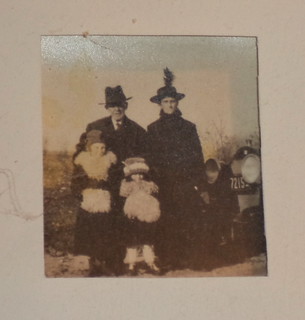
My great-grandmother was a striking beauty, my grandmother said. She was tall and willowy, with dark eyes. Gram remembered her as having an easy laugh. She didn't remember much about her father. The wedding picture we have shows him to be tall with light colored hair. My grandmother had red hair. My great-aunt, her sister, had brown hair.
She remembered her father lying on a cot in the porch. She remembered him being pale and she remembered hearing the coughing fits. She remembered the doctor coming, often, it seemed. She remembered going to the porch door and leaning her face against the glass. Her father would kiss the glass where her cheek was and wave her good night. When the photo to the right was taken, she was 7 and Irene was 5. Their father had been dead at least a year, at this point. The next year, their mother was gone, taken by the same illness. Francis and Irene went to live with Till and Edward, their father's sister. I do not know what happened to the man in the photo, the father of their mother.
I've ordered the book. I feel a need to know about the effects on society of this disease. I think the title of the program, "The Forgotten Plague" is a misnomer. The average person on the street doesn't know about it, but then, they don't know about the Spanish flu, which unleashed a pandemic at the same time as society was battling TB. Could your weakened effects from fighting the flu have left you more vulnerable to TB? How did the two feed off each other? There's so much I don't know.
Perhaps that's why the program felt incomplete to me. This is a topic which probably deserves more than the 55 minutes it's allowed on a Wednesday night. (That extra 5 minutes is for shilling all the corporate and foundational sponsors, you know.) I do know that the death of her parents had a profound impact on my grandmother. How many other children faced this loss? What was done with them? So many questions.
Beverage: Water
Deb
Tuesday, December 18, 2012
The Return
I watched more TV in 8 days than I did in the past 3 years, I think. There are some really, really awful Christmas movies out there. Just sticking "Christmas" in a movie's title does not guarantee it will be any good. Far from it. A movie still requires some semblance of a plot which some of these holiday movies didn't seem to have from the start.
I discovered the PBS "Create" channel. Heavily filled with cooking shows, it started off as something fun but I can only tolerate watching people cooking for so long before it's just boring. Another percentage is travel shows and those can be interesting. But again, I can only watch them for so long before it's just another place and you can interchange the country name with a different one.
"Miss Marple Investigates" was wonderful. I've read all of Agatha Christie's books so I enjoy seeing how it gets translated to the screen. There's usually one or two actors whose faces I recognize. In the one Miss Marple I watched, it was Joan Collins playing a socialite from New York. Hmmmm. Casting against type I see.
I watched "American Experience" and WGN TV's Bozo specials. I watched the news and the weather. I usually get both from the Internet. I watched football, all the football someone with free TV can watch. I watched "Bob Newhart" and "Mary Tyler Moore". I watched bits and pieces here and there until it got boring to watch more.
I managed to keep the worry monster away by concentrating on gratitude. At least someone was looking at the computer with an idea to try to get it working for me. Bill Moyers had a great program on Friday night discussing the "fiscal cliff" we've heard so much about. I actually watched a program discussing financial matters. After listening to the two people he had on his show, I am not worried much about the impending "fiscal whatever". That worry has been sent packing. It is what it is and I'll make do as I have before.

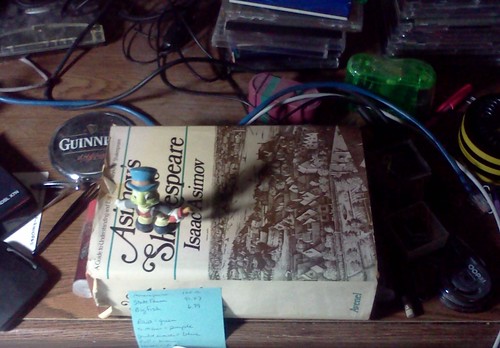
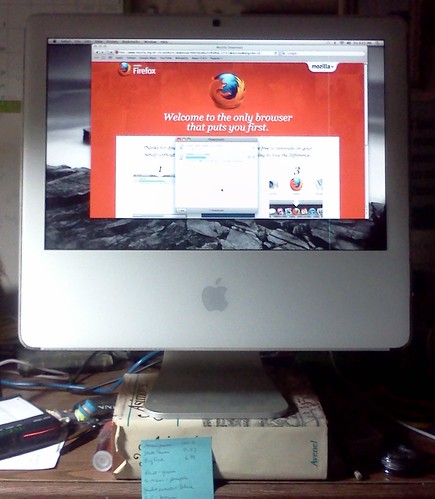
So, Friday night, I picked up the computer and set about getting the space ready again. A couple years ago, I realized that my chair made me spend too much time looking down at the computer screen. Ideally, you should look straight across. I looked around the house for something on which to set the computer to raise it up the required 3 inches. I've had this book "Asimov's Guide to Shakespeare" for at least 20 years. It's an invaluable help when I want to muse on Shakespeare's writings. It's also the perfect height to raise the computer up to eye level. So, I dusted around the book, moved a bunch of cables and set the computer back where it had been.
Then came the dreaded downloading. I have a new hard drive. Everything I had on my other hard drive has to be reinstalled. The operating system was an upgrade from the one I had been using. It has a few new quirks that are taking me some time to get used to.
Getting back online and getting my email services back up and functional didn't take that much time. Downloading World of Warcraft has been a trial. I think my Internet service throttles the amount of data I can download at once. I have 20 gigabites of data for this game and I'm downloading it in kilobite fragments. It's so slow. And when my computer goes to sleep, it doesn't download anymore so I have to supervise the downloading. When it's time for bed, however, I let it go and it just quits whenever the computer goes to sleep. There is a program I can download that will prevent the computer going to sleep, but I was able to log into the game on Sunday. I'll just keep going with the time I have. Eventually, the whole game will be downloaded.
I didn't really go through withdrawal without the computer. There were times, especially the first weekend, when I'd think, "I wonder...I'll just go look it up online...oh wait...", but, by Tuesday evening, I would come home, do chores, make supper and then sit in the recliner. Before computers, this is what I did. Had the computer been beyond repair, I would have been okay with that.
So, my eyes forward are toward a new computer. I don't know how much longer this one will limp along so I need to figure out how to pay for a new one. Computers are so much a part of life now and so much of how I entertain myself is tied up with the computer. Let's see if life lets me plan for a new one.
Beverage: Edinburgh's Finest tea
Deb
Thursday, March 25, 2010
It Means What?
My router died on Monday so I used the time to finish a magazine and start this book, which is my next read. It's quite light reading, maybe that's good at my advanced age. I enjoyed chuckling through the first chapter.Then I stumbled upon the following statement:
"You know you're old when you've thrown your back trying to open a can of pilchards."
Wha?
What the heck is a "can of pilchards"?
My big, black cat was named for Bob the Builder's cat. I knew nothing of this PBS cartoon until I had the opportunity to adopt this cat. I had seen a couple of graphics that showed Bob with a long-haired black cat standing by him. "Oh, okay." This sentence implies there's something more here.
So, a check of Wikipedia for "pilchard" and it's another name for sardine.
I just have to laugh. It's somewhat fitting, isn't it? Name a cat after aSardines, or pilchards, are a group of several types of small, oily fish related to herrings, family Clupeidae.[1] Sardines were named after the Mediterranean island of Sardinia, where they were once in abundance.[2]
The terms sardine and pilchard are not precise, and the usual meanings vary by region. Britain's Sea Fish Industry Authority for example classifies sardines as young pilchards.[3] One system of measurement suggests that fish shorter in length than 6 inches (15 cm) are sardines, and larger ones pilchards.[4] The FAO/WHO Codex standard for canned sardines cites 21 species that may be classed as sardines;[5] FishBase, a comprehensive database of information about fish, lists at least six species called just “pilchard,” over a dozen called just “sardine,” and many more with the two basic names qualified by various adjectives.
fish. Her royal highness does like tuna water.Plus, Bob the Builder originated in Britain. We don't call sardines pilchards. That's a very British term. Makes perfect sense why they would name a cat "Pilchard".
I looked today on the Bob the Builder site and there wasn't a cat to be found, or at least that I could see. That's kind of sad. I would liked to have seen the representation of my cat.
You know I'm going to think of sardines now when this feline decides she wants to lie in my lap. There is nothing "sardined" about 17 pounds of fur lying across my legs with her head on my arm preventing me from adequately killing mean baddies in my game. Yet, when she looks up at me....
Beverage: Earl Grey Tea
Deb
Thursday, September 3, 2009
Hissssss
Wednesday, June 3, 2009
Techno-clutz
My converter box still sits on the floor in front of the TV. Unopened. Still in the Best Buy bag. Still with the receipt.
I haven't actually watched TV since, I think October when I watched part of an Iowa Hawkeyes football game. I am on my computer now. I get my news from the paper and radio and the computer. Hence, once, back in January, when I turned on my TV to try to get an Iowa Hawkeyes basketball game, I wasn't totally shocked when every station was snow.
I don't have an outside antenna and I don't have cable. I just don't watch TV. Given the lack of decent programming, I see I'm not missing much. But there have been times I might have watched PBS for "The American Experience" or "Nova" or "Frontline"AFTER I see what was on that I missed. Because I know turning on the TV results in snow, I don't even bother to check the listings anymore.
But, I would kind of like to have it working again.
That means I need to get the TV working. I need some signal booster thingee that attaches to the back of the TV and then the converter box goes onto that or some such thing. I took a lot of pride in being able to 1) make the VCR stop flashing and 2) make the VCR show the right time. I look at the back of my TV and think, "No way".
So, if any of my friends think they can make it so the TV and converter box work, I'll buy dinner.
Beverage: Market Spice Huckleberry Tea. This is good stuff, Maynard. (Points for knowing that reference.)
Deb