
This building is, itself, historic. I didn't know this information.
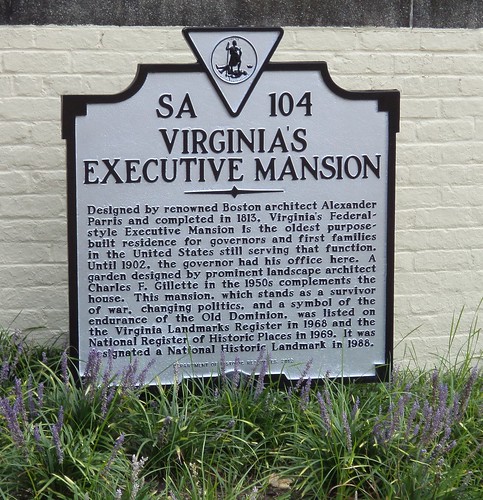
I didn't look to see if there are tours of it. When Carole was named a Lincoln Scholar while at North Central College, we got to have lunch in the Illinois Governor's Mansion. I didn't bring a camera that day. I don't know why, so I have only memories of a large room, painted a robin's egg blue, and filled with scholars and their families. I'm wondering if the Virginia mansion has a Christmas tour. If so, I'll bet it's very nice. Something to consider.
There is a second executive mansion in Richmond. This one is located 3 blocks northeast of the capital building.
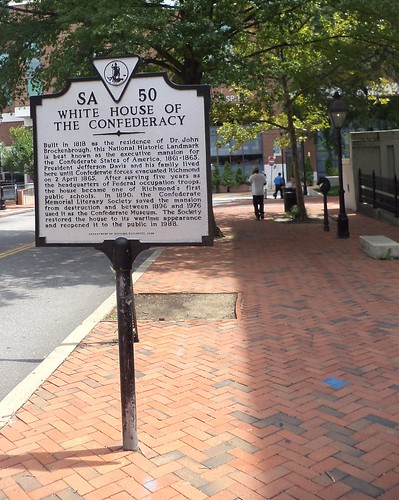
The building itself is rather unassuming, although you can tell it's old even if you didn't know what it was.

In 2001, we took the tour of the building. I don't remember anything about the tour. The building is conveniently located next to the Museum of the Confederacy.
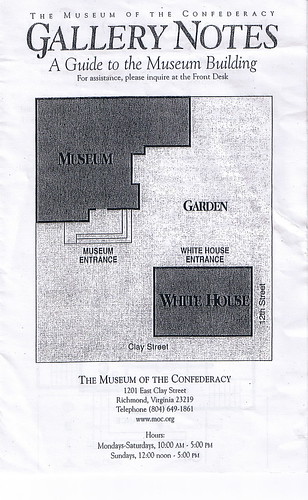
You get your tickets for the house tour inside the museum and then walk across the lot to the building. I thought we went in the front door when we were there in 2001, but the tour I saw went in through the back door, through the back garden. I did not take the tour because of the stairs involved and I was beginning to feel it in my knees. Plus, the museum had an exhibit I really wanted to spend time with.

Entitled "Gettysburg: They Walked Through Blood", it tells the story of Pickett's Charge through the flags of the regiments involved as well as letters and other artifacts. (This was the 150th anniversary of the Battle of Gettysburg.) Although there were quite a few people taking photos, I felt uncomfortable taking more than just this one. I don't even remember which regiment this is from. I needed to sit down as my knees were reminding me I must rest and this was in front of me.
What I found telling about this exhibit was how important it was to capture the battle flags of a regiment. Prior to this, I knew of battle flags and how they marked the different regiments involved in a battle. There were 15 battle flags involved in Pickett's Charge. Thirteen of them were captured. The Union gave out medals to men involved in capturing Southern flags. I have to say this fact bothered me. I realize it was a different time but awarding medals for capturing a flag of US citizens, even those under revolt, made an impression on me.
Captured flags were sent to the War Department and put into storage. Some of them had the names of the regiment written on them. It looked like magic marker but I was told it was black paint. In 1905, Congress gave those flags associated with Southern regiments to the museum. The first flag was donated in 1895 and, since then, they have accumulated a total of 685 flags. Considering these are 150 years old, the efforts of the museum to preserve them is especially noteworthy.
These flags were generally made from silk, as it took color better, was easier to sew and was a lighter weight than other materials. But silk is a fragile material. It tears easily and being taken into battle, a flag was subject to all sorts of stress from being rolled and unrolled and wadded up to even just being shot at. Add that some flags fell to the ground and were trampled until rescued and preservation consisted, early on, of simply sewing the flag to another piece of silk so all the pieces were kept together.
I was intrigued by how they hang a flag for display. I know about that thing called 'gravity'. If you've ever been in a house that is more than 100 years old and still has original windows, you will notice the glass in the windows is thicker at the bottom than at the top. Gravity is slowly pulling the glass to the bottom of the window. The same thing happens to anything vertically mounted. So how does a museum which has a huge number of flags display something so fragile? They buy specially created flag cases.
As a museum curator explained to me, the case is in three parts. There is a base and a pad. The flag is laid on this pad which is attached to the base. Then the top is carefully lowered onto the base over top of the flag and pad. It creates a sandwich. The flag, while still subject to gravity, can't move inside this mount. All the glass and the pad are archival quality, meaning there are no chemicals known to harm the fibers of the flag present in the mount. The mount is air tight and UV quality. While they would never hang the flag in direct sunlight, they can illuminate the flags with museum lighting. The best preservation would be to have the flags wrapped in archival tissue paper and lying flat in dark drawers in a climate controlled facility. But part of preservation, he said, is allowing the public to view these. For some people, who had relatives who marched under a certain flag, there is great meaning. This is, currently, the best possible way to show off flags in their collection. It's also very expensive.
So, I didn't take the tour of the Confederate White House and spent it pondering Pickett's Charge, among other things.
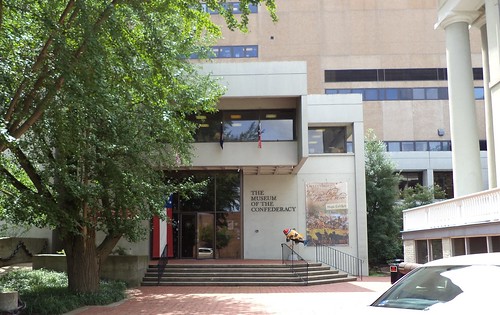
You see the pillar of the White House to the right. The museum is a small building set amongst the huge medical complex of Virginia Commonwealth University. When Carole and I were here in 2001, the land behind and to the left was open. The museum almost gets swallowed up in the medical complex.
A long time ago, I had an idea that, as a goal, it would be neat to tour the capital building and governor's mansion of all 50 states. I've never done anything with that idea. Perhaps, as my vacations will probably include a yearly trip to Virginia, I could start here.
Beverage: English Breakfast tea
Deb


