Showing posts with label theatre. Show all posts

Saturday, February 20, 2016

Book #6

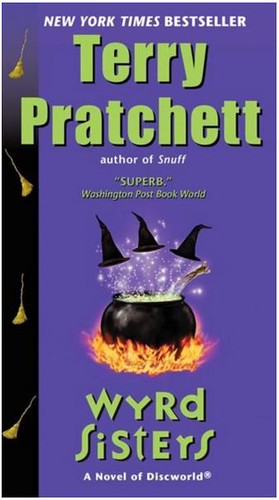
This is going a bit better than I expected. I can finish a book about every 3-4 days. It does mean, to read the whole series, I need to read a book a week, but that seems a reasonable goal. I finished book 6 last week.


It's the return of Granny (Esme) Weatherwax and introduces Nanny Og and Magrat. (I kept reading her name as "Margrat". It was just easier, eventually, to acknowledge I don't see her name as written, but, right now, she doesn't seem to mind.)

I think this is the first book where many threads of a story are introduced, left dangling, and then tied up somewhat neatly at the end, with the thought that some of the characters introduced will be back in later books. This is a rollicking good read and stands alone as a story in and of itself. You don't need to have read "Equal Rites" to get a feel for who Granny is. She's softer in this book. I still felt she was a bit of a bully, but the storming into lives and simply demanding people do what she thinks should be done, has been softened. She's got two other witches acting as foils and, although they aren't the fierce character she is, they are written as having good and nobel and right answers to the problems posed in the book.

The story, around which all the other threads dangle is that the king of Lancre is murdered by his brother. The king had a son and sympathetic guardsmen scooped up the infant and got him out of the castle immediately after the king's demise. He's given to the witches who place him with a traveling theatre troupe. The boy grows up within the theatre. The duke, who murdered his brother, makes life hard for the witches and goes increasingly mad.

The story is built on Macbeth with bits of Shakespeare's lines wandering through the book, not quite lost, but not quite sure why they are here. "Is this a dagger I see before me?" and "Out out damned spot!" make appearances and the duke's madness owes its origins to Lady Macbeth's madness. If you know Macbeth, you'll laugh at how that play weaves its way through the chapters.

What I liked best, was the discussion of the theatre versus magic. I think this quote sums things up nicely. The theatre troupe is called to Lancre to stage a play where the king who died is portrayed as horrible and the duke is portrayed as nobel. (You'll recognize that trope from Hamlet.) The witches are increasingly accosted as evil in the kingdom where they live and have lived all their lives. They lead respectable lives and people depended upon them, but the duke feels they know too much and he needs to destroy them. "Double, double, toil and trouble" shows up too.

The witches attend the premier performance of this play where the language of the theatre will be used to rewrite history.

"Granny subsided into unaccustomed, troubled silence, and tried to listen to the prologue. The theater worried her. It had a magic of its own, one that didn't belong to her, one that wasn't in her control. It changed the world, and said things were otherwise than they were. And it was worse than that. It was magic that didn't belong to magical people. It was commanded by ordinary people, who didn't know the rules. They altered the world because it sounded better."

I never looked at the theatre in that way before. I've read this book previously, but I didn't remember much of the story. I came into the book expecting to dislike Granny and felt, with this paragraph, a kind of sadness for her. This isn't what she's used to and it really bothered her.

And yet, there is a magic in the theatre. A well-written, well-staged play is like bottled magic. It transports you to a different view of a story. Pulitzer Prize winning plays get that recognition because they envelope you and have you see things just a bit differently. Even something as silly as "Spamalot" has a wonderful kind of magic that helps you forget your cares for 3 hours. Best of all, that magic belongs to us and we can all see it, feel it, touch it.

Things work out in the end, although there is some question about the new king of Lancre. I'm hoping that gets resolved down the road. Now, it's on to new people in a different section of Discworld. I'm a third of the way into book #7.

Beverage:  Dr Pepper

Deb

Monday, June 10, 2013

Summer Reading

I've started out with a bang. In years past, The Bookstore, in downtown Glen Ellyn had this summer reading program. You were to read 10 books between Memorial Day and Labor Day, fill out a form with a bit about the book and turn it in by the weekend after Labor Day. When you did that, you got a free paperback. Never mind that this works out to about a book every other week, if you're a voracious reader, you probably can finish this off by the beginning of August.

Me? Well, it really depended upon what life was like. Some years, I finished 12 books with time to spare. Other years, I barely made it through 4, let alone 10. They had to be age appropriate, too. I couldn't fill my paper with "The Very Hungry Caterpillar", etc, and call it done.

I have gone through a period where my reading has been pretty much confined to magazines and the instruction sheets that go with craft projects. I'm not sure why but I'm drawn to the stack this summer. It could be that's because there is an adaptation of Shakespeare coming to movie theatres this Friday.

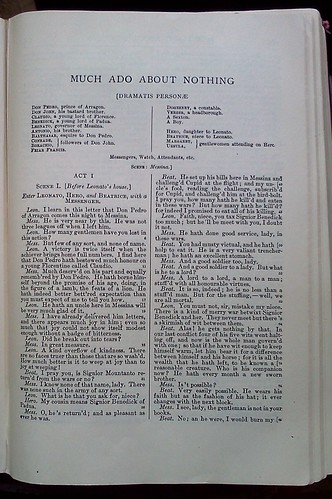
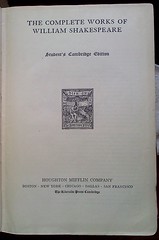
"Much Ado About Nothing" is not one of Shakespeare's finest. I hadn't read this play since probably college, so I dug out my Complete Shakespeare and dove in.

This is a frothy tale employing one of Shakespeare's favorite comedic conceits, the masquerade wherein people claim to be whom they are not and the repercussions of this action. The hero and heroine of the story, Claudio and, aptly named, Hero, meet and Claudio falls madly in love with her on sight. She is wooed by Claudio's boss, Don Pedro, and she agrees to marry Claudio. The villain, an illegitimate brother to Claudio's boss decides to break them up and has his henchmen stage a rendevous with Hero's maid at night while Claudio overhears from a nearby orchard. Thinking Hero has just agreed to meet with another man, he publicly humiliates her the next day, at their wedding. Hero faints and several people agree to tell Claudio that she has died, while the local constabulary accidentally arrest the conspirators and elicit a confession. The final act sees all this madness come to resolution and Claudio and Hero happily together about to be married. The whole of this happens under the auspices of a large party to welcome Don Pedro back from an unspecified  successful military campaign.

There are problems with the play. The action takes place over 3 days. Truncating the action like that leads to a great need on behalf of the audience to suspend disbelief and agree that things can happen this quickly. Even "Hamlet" is allowed to play out over several months. "As You Like It", which employs a similar 'people not who they say they are' concept, gives the characters some time to get to know one another. The villain, Don John, is given little motive for doing what he does. He's mentioned as being illegitmate, but in stronger plays, that means someone's been cheated out of an inheritance or ostracized from court. This guy seems to want to be mean just because he can. That's never a very deep well of motivation for a villain. Also, he escapes the police, who have his accomplices, and the movie ends with the announcement that he's sent his army to attack his brother.

The best lines in the play are not from the two lovers. The leads in the play are Beatrice and Bernardo and much of the richness of language, the humor and the resolution of the plots many strings comes from their banter. We meet them before we meet Claudio and Hero and, from the early language understand they have had a long relationship marked by verbal swordplay. Their exchanges are some of the best written lines in this play. The fact that they use their verbal sparring to keep each other at bay when it's clear they love each other is quite amusing. When they come together at the end, accepting that love, it is, I think, a much bigger thrill than Hero being revealed as alive and Claudio finding out he was duped.

The title of the play references all the little twists and turns contained in it. When it comes to love, the bumps and pot holes to get from meeting to marriage are not important, much ado about nothing. True love finds a way. We might have to help it along, but even left to its own devices, it will find a way.

I'm excited to see this adapted for the movies. Will Joss Whedon, director, carry this through? Will he keep the banter between Beatrice and Bernardo at the intensity it is in the original? Will he flesh out Don John and give him more of a reason to be a villain? Will the audience get half of what's going on or will they simply come to see Nathan Fillion call himself an 'ass'? I suppose there are worse ways to get people to hear the words of Shakespeare.

Reading Shakespeare caused me to think about an author I don't think I've read since college. There has been a long, long, long running discussion; in some places of academia, an argument; that the man, William Shakespeare, did not write the plays attributed to him. The one piece of "evidence" used to frame this discussion is that the man called Shakespeare was not educated enough to create such astounding works, to create over 5,000 words which were added to the lexicon. It is known that he was in the theatre but he was just a would-be writer and just didn't have the smarts or social standing to write these intricate works. One of the people associated with this conspiracy is Christopher Marlowe.

Marlowe died in 1593, well before Shakespeare's plays were considered for the stage or before some of them had been written. Some of the conspiracy theorists have Shakespeare killing Marlow and stealing his compositions, affixing his name to them. The two were contemporaries although there is no evidence they ever met. It is known that Shakespeare knew of and read Marlowe's plays and was influenced by his style.

I'm not sure why the association popped into my head, but as I was planning to read Much Ado, I thought of Marlowe and his play "Doctor Faustus". It's based on historical information from Wittenberg, Martin Luther's home town, about a theology student who sold his soul to the devil in exchange for riches. Supposedly this happened shortly after Luther nailed his 95 Theses to the door of the cathedral. This story was "all the rage" with the court and Marlowe tapped into that.

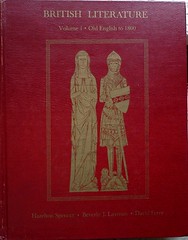
So, I hauled out my big red British Literature book Volume 1 and opened it up to "Doctor Faustus". The premise is simple. A theologian takes up the offer of two others to learn magic and conjures Mephistopheles who says he cannot be the man's servant unless the man sells his soul to Lucifer. There is an on-going dialog between good and evil angels and a final ending wherein either the theologian outwits Lucifer or Lucifer claims the soul. Honestly, I don't remember if this was written as a cautionary tale, lest someone be tempted towards the 'dark arts', or an uplifting story of redemption. It's long, much longer than one of Shakespeare's plays and does require a bit more out of a reader. I reached Act II Scene II yesterday before closing the book to finish chores.

The theatre starts my summer reading. Where it goes from here is going to be a surprise to me. I shall let my eyes pick the next books; there's merit in buying a book because it looks good; and we'll see. What are you reading this summer?

Beverage:  Berry-flavored Seltzer

deb