Showing posts with label non-fiction. Show all posts

Monday, June 10, 2013

Summer Reading

I've started out with a bang. In years past, The Bookstore, in downtown Glen Ellyn had this summer reading program. You were to read 10 books between Memorial Day and Labor Day, fill out a form with a bit about the book and turn it in by the weekend after Labor Day. When you did that, you got a free paperback. Never mind that this works out to about a book every other week, if you're a voracious reader, you probably can finish this off by the beginning of August.

Me? Well, it really depended upon what life was like. Some years, I finished 12 books with time to spare. Other years, I barely made it through 4, let alone 10. They had to be age appropriate, too. I couldn't fill my paper with "The Very Hungry Caterpillar", etc, and call it done.

I have gone through a period where my reading has been pretty much confined to magazines and the instruction sheets that go with craft projects. I'm not sure why but I'm drawn to the stack this summer. It could be that's because there is an adaptation of Shakespeare coming to movie theatres this Friday.

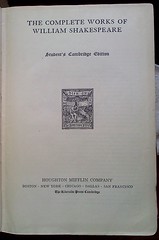
"Much Ado About Nothing" is not one of Shakespeare's finest. I hadn't read this play since probably college, so I dug out my Complete Shakespeare and dove in.
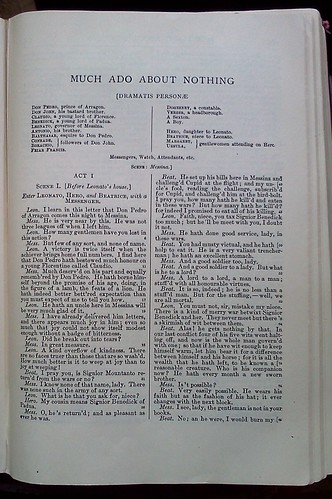
This is a frothy tale employing one of Shakespeare's favorite comedic conceits, the masquerade wherein people claim to be whom they are not and the repercussions of this action. The hero and heroine of the story, Claudio and, aptly named, Hero, meet and Claudio falls madly in love with her on sight. She is wooed by Claudio's boss, Don Pedro, and she agrees to marry Claudio. The villain, an illegitimate brother to Claudio's boss decides to break them up and has his henchmen stage a rendevous with Hero's maid at night while Claudio overhears from a nearby orchard. Thinking Hero has just agreed to meet with another man, he publicly humiliates her the next day, at their wedding. Hero faints and several people agree to tell Claudio that she has died, while the local constabulary accidentally arrest the conspirators and elicit a confession. The final act sees all this madness come to resolution and Claudio and Hero happily together about to be married. The whole of this happens under the auspices of a large party to welcome Don Pedro back from an unspecified  successful military campaign.

There are problems with the play. The action takes place over 3 days. Truncating the action like that leads to a great need on behalf of the audience to suspend disbelief and agree that things can happen this quickly. Even "Hamlet" is allowed to play out over several months. "As You Like It", which employs a similar 'people not who they say they are' concept, gives the characters some time to get to know one another. The villain, Don John, is given little motive for doing what he does. He's mentioned as being illegitmate, but in stronger plays, that means someone's been cheated out of an inheritance or ostracized from court. This guy seems to want to be mean just because he can. That's never a very deep well of motivation for a villain. Also, he escapes the police, who have his accomplices, and the movie ends with the announcement that he's sent his army to attack his brother.

The best lines in the play are not from the two lovers. The leads in the play are Beatrice and Bernardo and much of the richness of language, the humor and the resolution of the plots many strings comes from their banter. We meet them before we meet Claudio and Hero and, from the early language understand they have had a long relationship marked by verbal swordplay. Their exchanges are some of the best written lines in this play. The fact that they use their verbal sparring to keep each other at bay when it's clear they love each other is quite amusing. When they come together at the end, accepting that love, it is, I think, a much bigger thrill than Hero being revealed as alive and Claudio finding out he was duped.

The title of the play references all the little twists and turns contained in it. When it comes to love, the bumps and pot holes to get from meeting to marriage are not important, much ado about nothing. True love finds a way. We might have to help it along, but even left to its own devices, it will find a way.

I'm excited to see this adapted for the movies. Will Joss Whedon, director, carry this through? Will he keep the banter between Beatrice and Bernardo at the intensity it is in the original? Will he flesh out Don John and give him more of a reason to be a villain? Will the audience get half of what's going on or will they simply come to see Nathan Fillion call himself an 'ass'? I suppose there are worse ways to get people to hear the words of Shakespeare.
Reading Shakespeare caused me to think about an author I don't think I've read since college. There has been a long, long, long running discussion; in some places of academia, an argument; that the man, William Shakespeare, did not write the plays attributed to him. The one piece of "evidence" used to frame this discussion is that the man called Shakespeare was not educated enough to create such astounding works, to create over 5,000 words which were added to the lexicon. It is known that he was in the theatre but he was just a would-be writer and just didn't have the smarts or social standing to write these intricate works. One of the people associated with this conspiracy is Christopher Marlowe.

Marlowe died in 1593, well before Shakespeare's plays were considered for the stage or before some of them had been written. Some of the conspiracy theorists have Shakespeare killing Marlow and stealing his compositions, affixing his name to them. The two were contemporaries although there is no evidence they ever met. It is known that Shakespeare knew of and read Marlowe's plays and was influenced by his style.

I'm not sure why the association popped into my head, but as I was planning to read Much Ado, I thought of Marlowe and his play "Doctor Faustus". It's based on historical information from Wittenberg, Martin Luther's home town, about a theology student who sold his soul to the devil in exchange for riches. Supposedly this happened shortly after Luther nailed his 95 Theses to the door of the cathedral. This story was "all the rage" with the court and Marlowe tapped into that.

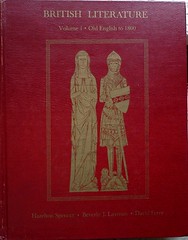
So, I hauled out my big red British Literature book Volume 1 and opened it up to "Doctor Faustus". The premise is simple. A theologian takes up the offer of two others to learn magic and conjures Mephistopheles who says he cannot be the man's servant unless the man sells his soul to Lucifer. There is an on-going dialog between good and evil angels and a final ending wherein either the theologian outwits Lucifer or Lucifer claims the soul. Honestly, I don't remember if this was written as a cautionary tale, lest someone be tempted towards the 'dark arts', or an uplifting story of redemption. It's long, much longer than one of Shakespeare's plays and does require a bit more out of a reader. I reached Act II Scene II yesterday before closing the book to finish chores.

The theatre starts my summer reading. Where it goes from here is going to be a surprise to me. I shall let my eyes pick the next books; there's merit in buying a book because it looks good; and we'll see. What are you reading this summer?

Beverage:  Berry-flavored Seltzer

deb

I Have a What?

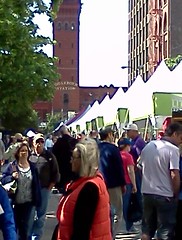
It was the Printer's Row Lit Fest this past weekend. It could not have been better weather for it. I went on Saturday. It was clear and sunny for the whole day with temperatures in the mid-70's. I have been down there, walking amongst the throngs, when it's been 90 so the fact that it was in the 70's seemed, to me, to be a talisman for excitement and discovery. The camera went missing the evening before. Of course, I found it in the pocket of my messenger bag on Sunday, so I had to take photos with my cell phone. It doesn't look clear but trust me, there was beautiful blue sky with nary a cloud in sight.

I like to get there early because a loathe the crowds that don't allow you to look. A book fair like this, in reality, isn't a place for someone like me. I go with a list of books I am on the prowl to buy. That list, this year, included Erik Larson's most recent which is, now, 2 years old with a paperback version out; any Discworld books I haven't read and given that there are upwards of 25 in the series and I'm really not half-way through them, I should find more than a few I haven't read; and anything by Flannery O'Connor. My best friend, Patt, (not to be confused with my best friend, Pam) sent me a brilliant article discussing some of O'Connor's work. I know 'of' her, but I never took "Contemporary American Literature" while in college so never read anything she wrote. After reading this article, I need to get something and add it to the stack.

Last year, I got a Godzilla poster which, sadly, remains unhung. I just haven't found the right spot for it. So, visiting places with posters is a waste of time. I have no wall space without removing something I currently have on the wall. I have a lot of things unframed that I want displayed, so I passed those booths by. With a list of authors I wanted, I was unmoved by the hardcovers at $5 or the paperbacks at $1. And the sheer crush of people means taking the time I want to browse mean inconveniencing people behind me who also want to see what's offered. So, I wound up doing a quick scan of titles and moving on. I also wish, but I'm sure it's quite impossible, that sellers would organize their offerings better. It would save time for me. I think they feel that if everything is jumbled together, it forces you to linger, to look and will, thereby cause you to find something you didn't know you needed.

I always, always head first to one tent, Lake Claremont Press. This small press is regional publishing at its finest. If you are interested in Chicago and its history, their extensive list of books are sure to have something you will like. My interest in this publisher stems from finding, years ago, a book called "Chicago Haunts" by Ursula Bielski. I get announcements from them and I'm always excited to see what they have on offer, so my first stop at the book fair has always been their tent...except...when I can't find them.

That was the case last year. I walked all over the fair looking for their name on the tent and it was nowhere to be found. What I discovered, the next day by checking out their Facebook page, was that they had been sandwiched into a tent with three other regional presses. I must have walked by them three or four times and never saw the name on the proper side of the tent.

This year was different. Viola.


There is the Lake Claremont Press tent. Four sides of literary goodness. I walked all around looking at the books. I did get "Wrigley Field's Last World Series", a book about the last time the Cubs were in the World Series, 1945. My dad often talked about this event. It will be an interesting read.

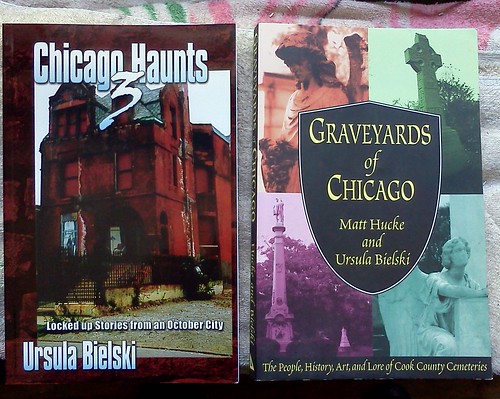
But what I really wanted was to check on the upcoming book, "Graveyards of Chicago". I have a copy of this. I've had it for years. It's in the stack to be read. In fact, I found it, pulled it out of the stack and brought it along to show them. I enjoy Ursula's books. I'm pretty sure there are two or three on the shelf in the basement.

As I was standing there, chatting with a gal, a woman came up and I was told to talk to her. So, I showed her the book and asked about the upcoming one.


She looked at my book and said, "Oh my gosh. This is a first edition. Do you realize this sells on eBay for $100 because it's out of print?"

I was floored. (A subsequent search reveals that my pristine copy, which I hadn't gotten around to reading, was worth $150, although it could go higher if I did a bidding war on it.) I have never owned a first edition of any book. I've seen them. I've drooled over the idea of having a first edition, but usually those books are, as this lady said, $100 and up, and I can't really justify spending that kind of money on a book. To possess such a thing, on accident, left me speechless. When I mentioned that I was embarrassed to admit I hadn't even read it yet, the lady said, "Oh don't bother. The new one is coming out soon. I'm really proud of it. We put a lot of work into updating it with more accurate information." That's when it dawned on me. (I can be, admittedly, slow on the uptake sometimes.) I was talking with Ursula herself.

I hope my subsequent comments were not too effusive. I don't run in the circles where the meeting of authors would be commonplace. To actually meet the author of books I have admired and enjoyed was a thrill. I wound up buying "Chicago Haunts 3". It's the next book to be read this summer.

What was also a huge thrill for me was to have Ursula autograph my books. Here's the "Chicago Haunts 3" autograph.


And yes, I had her autograph, personally, the first edition. That does diminish its value, but I am NOT selling it. This falls into the "prized possession" category now. I have a personalized, autographed first edition AND I met the author.

I didn't find anything else at the fair and, actually, I didn't really care. This was an amazing set of occurrences. This 15 minutes made my whole day. In the grand scheme of finding things to be grateful for, I can live off this event for weeks. That might seem like hyperbole, but it's things like this that make me really happy. Now I have to make time to find the other titles I own by Ursula and arrange all of these on a shelf where they are visible.

Beverage:  Yorkshire Gold tea

Deb

Friday, August 26, 2011

Day 26-A Book you wish would be written

I don't have an idea for this topic. It's been bugging me all morning. Do some work. Stop. Think about the topic. Do more work. Stop. Think some more.

On Wednesday, I said there's never not going to be a need or desire to tell stories as long as we communicate. The topics we use, the language we use, the manner in which we tell our stories reveal a lot about who we are and our desire to communicate our wants and needs to others.

The writing of a book is a very personal adventure, regardless of whether your book is set in the here and now and deals with the guy across the street and his vegetable garden or if it's set on a world where rabbits rule and humans are the ones who steal the carrots in the middle of the night. Every book, even the terribly awful one by John Travolta which I used at the beginning of the month, is a window into the author's soul, his or her thoughts and feelings and how they view life.

When I read fiction, I gravitate toward those books deemed "classics". This generally means something written before 1920. There are writers whose works have entered the literary pantheon and who lived and still live in current times. I might get to them some day.

I gravitate towards non-fiction. I believe part of that is my life-long desire for knowledge. One of my favorite aphorisms is "The truly educated never graduate." Non-fiction fills the desire to know and to learn.

When, in my infrequent forays into bookstores, I wander about, I realize there are books about pretty much anything. Cooking:  Vegan, Gluten Free, Making Cheese. I typed "Arthritis Cooking" in the Barnes and Noble search engine and up popped 32 different results. Some are the same book in hardcover and paperback, but there's a cookbook for what I'm going through.

I typed in "Counted Cross-Stitch" and up popped 45 results. And if I type in "Cats", I have over 700 choices to peruse. Erik Larson of Isaac's Storm and Devil in the White City fame has a new book out. I didn't know about that. I'll have to see if I can save up for it. So what could I possibly want to read that hasn't been written?

I thought of something as I was perusing the virtual stacks in the fields I enjoy. There isn't a biography of Terry Pratchett, author of Discworld. Perhaps that is by design, but someone needs to be working on that as he has Altzheimers. 

Beverage:  English Breakfast tea

Deb

Thursday, August 25, 2011

Day 24 - A Book you later found out the Author lied about

I hit this topic yesterday. My first reaction was, "Who picks these topics?" After thinking about it for a whole day my reaction still is, "Who picks these topics?"

I don't know how long this 30-Day Book Challenge has been up on Facebook because I'm a Facebook novice compared to others. It strikes me as pulled from the headlines, specifically the James Frey controversy over his A Million Little Pieces memoir. I've not read this book and probably won't. It does not interest me.

But, I've been thinking about all the books I have read over the years. I started in fiction. Someone's ability to tell a good story will never, ever not be needed as long as humans can communicate. Reading Rainbow's theme song defines storytelling.

Butterfly in the sky
I can go twice as high
Take a look
It's in a book
A Reading Rainbow

I can go anywhere
Friends to know
And ways to grow
A Reading Rainbow

I can be anything
Take a look
It's in a book
A Reading Rainbow
A Reading Rainbow

Books transport you to places you wouldn't be able to go. Books will assault your senses on topics you may have avoided. Books help heal. Books provide laughter and can make you cry. I've done all these things and more with a book.

As my tastes in literature changed, I have gravitated toward non-fiction and history. I look through my pile and over 70% of the books in the to be read stack are non-fiction. When I wander a bookstore, that's where I find myself. In the past, I would have spent time in fiction. How can you say an author of fiction lies when, technically, the whole thing is made up anyway? So I can't point to a fiction work and say the author lied.

I could point to the Nancy Drew series and say the publisher lied to me. I always thought Carolyn Keene was a real person and I was amazed at her ability to churn out a new book about every 6 weeks and have them be as good as they were. It's only in the last 20 years that we've come to know it was a series of authors who wrote them and the Hardy Boys books. 

I don't think I have ever found out later that the author of a book I read lied to me. Non-fiction and history books have to, by their topic, be researched and contain a bibliography. I like to read the bibliographies in books like Erik Larson's Isaac's Storm. It gives me a sense that if I really wanted to check his veracity, I could read anything he cites as a source.

Hence, I have nothing for this topic. Perhaps, had James Frey not been called on the carpet by The Smoking Gun or Oprah, there would be more books where authors fudged or outright lied. But, we live in a world now where what you did 20 years ago as a rambunctious teenager can be found out. You don't have the ability to hide. If you write something about your life and say, "I broke Mrs. White's windows on that gray Sunday morning while she was at church," you better have done that because, if you didn't, we'll find out.

I'm unsure if that's good or bad.

Beverage:  English Breakfast tea

Deb

Monday, August 22, 2011

Day 21-A guilty pleasure book

This topic made me laugh. Define 'guilty pleasure'? An afternoon spent reading The Complete Calvin and Hobbes instead of doing dishes could be defined as a 'guilty pleasure', but is that what this means?

I read erotica. Some of it has been about as good as it gets. Most of it falls into the "huh", category. 'Guilty pleasure'? Not really. I haven't read anything in that genre in 15+ years.

I think my definition for the purposes of finding a book is the book is something people might snicker at if you read it in public, or something that is a bit off what people usually see you read. I couldn't find my copy of this book, but I think it fits both definitions nicely.

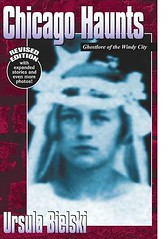
I love a good ghost story and the fact that these are set in the area I have adopted as my home makes them doubly good. The most recent poll I could find says that 20-25% of the population believes in ghosts. Some of the stories in this book, such as Resurrection Mary (the subject of the cover illustration), are well known but haven't happened in decades. Some, such as the spirit of Clarence Darrow appearing at the lagoon behind the Museum of Science and Industry, happen every year. You have to be in the right place at the right time.

Still, if you were reading this on the el, the famous elevated railway in Chicago, people would be bemused. You're probably reading it just out of curiosity or you're one of those punks who is going to show up at Graceland Cemetery and try to get in at night. (You can't, for the record. They have exceptional security.) It would not occur to people that you might be interested in the paranormal or that you're looking for a spine-tingling read.

This could be considered a 'pulp' book. It's just a collection of stories and the follow up book was even more so. There wasn't anything really spine-tingling. But this was a great read, nonetheless. Some night, on the night Dillinger was killed, I'd like to gather my nerves and stand by the Biograph just to see if anything happens. There's a great industry in Chicago Ghost Tours. Wanna go with me? I'm too chicken to go alone.

Beverage:  Pepsi

Deb

Day 20-A Book you would recommend to an ignorant/racist/closed minded person

This is, for me, a problematic topic. I've stated before my personal stance against recommending books to anyone. What I like is probably not what you like. By way of illustration, a college friend and I were going to do a "book a month" book discussion. She chose My Antonia by Willa Cather. It's a great book. We actually spent 6 weeks discussing things we found in the book. My choice was House of the Seven Gables by Nathaniel Hawthorn.

I had never read it and have always been intrigued by it. It's considered a minor classic. Becky couldn't read it. She got through about 5 pages and said it was just not something she could ever see herself reading. It was way too dark for her. The book is about redemption and how it comes in a variety of forms but you have to get through the set up to see how it plays out. I felt badly that I would choose something she really, really did not like.

I also have a tendency not to choose people in my social circle who could be described as "ignorant, racist or closed-minded". Do we have differing points of view? Absolutely, but I can't think of someone I know who falls into those categories. I wouldn't have them as friends and, by extension, wouldn't recommend a book to them. I would never recommend a book to someone I don't know without a long discussion of what they like to read.

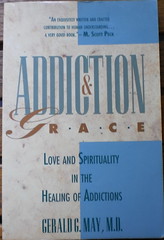
But there must be something I can put in this topic. Yes, there is. I picked up this book in 1993. I was in therapy at the time, struggling with a variety of things that were making me terribly unhappy. My therapist suggested that I have a co-dependent personality and that I was addicted to the actions and behaviors which described this. I do not remember how I found this book, but I do remember it struck a chord with me.

We can become addicted to so much in life. It's not just alcohol or tobacco, it's behaviors; playing video games and acting like a diva, to name a couple of things. The book talked about how to get rid of the addiction, regardless of what it is. I remember reading it 3-4 times a year for 5 years, while I worked to better myself and get over my co-dependency.

I would recommend this book to someone matching the title description. I think the theme of grace in one's life applies to addictions as well as to ignorance and racism. Yes, this book leans on the Christian tradition of grace, but the author talks about why we become attached to things and that can apply to why we view others in a less than good light. I never felt talked down to while reading this and I think that approach is good. It's not very big and it can be read in about 2-3 hours. It's a good book to have in your library for those times when you feel you need a refresher on how you conquered your addiction in the past.

Beverage:  Pepsi

Deb

Wednesday, August 17, 2011

Day 15- Favorite book dealing with foreign culture

Now that the ants seem to be under control, I have books to attach to themes.

Thank goodness I've kept book notes. This theme was hard. When I looked through my notes, however, I found the perfect book.

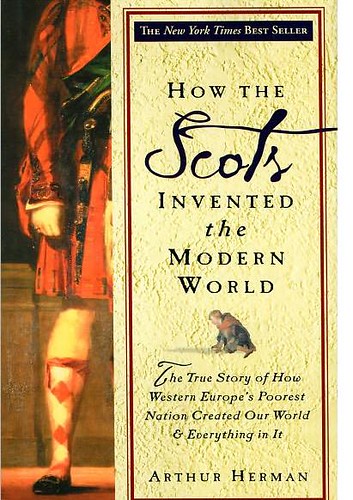
Now, you don't have to agree with the premise. You can think that it really was a bunch of Germans or Norwegians or Japanese who invented things first. What I think you should take away from reading this is part of the subtitle, "The true story of how Western Europe's poorest nation...". That's the part that is remarkable about the Scots, whether you believe they were first to invent the things the author claims they were.

Scotland has a fertile lowland area where crops easily grow. But the Highlands, the romantic area we generally associate with Scotland, is not fertile. It's rocky and windy and it's hard to eek out an existence in substandard soil. Thousands of years of war with the neighbors to the south and a 'royalty' that couldn't even get along with one another had left Scotland a very poor place.

But visionaries within the country realized that the way up, out of poverty, was to raise the living standard of everyone. Schooling became mandatory and at one point, Scotland's literacy rate was the highest in the world. In the 17th Century, it became mandatory to record births, deaths, marriages and land transfers. A census was instituted, the first of its kind to actually count citizens. Now days, all these records are a boon for those doing ancestral research.

So many things invented by a Scot became the foundation to expand knowledge and provided a better way of life. For example, Macadam Roads, a method of building a road so water drained off the road to the side, lead to the connection of all towns in Scotland by a single track road. Having a good road on which to test things lead to the pedal bicycle and the pneumatic tire.

The author's style is conversational and I thought, but I could be a bit biased, that it was a great read. When I have a tent at a highland games, it's one of the books I have out on the table and strongly recommend people read to get a feel for where they come from.

Beverage:  Scottish Blend tea

Deb

Friday, August 5, 2011

Day 5- A Non-fiction book that you actually enjoyed

Non-fiction is my preferred genre. If you look at my stacks, you'll see more non-fiction than fiction. When I read fiction, I tend toward classics or other books by an author I've already read and like. I see book referrals as very subjective. What I like, you may not. Hence I hesitate to give someone an opinion on a book. I don't want to saddle them with a book they won't finish.

The list seems to think that people prefer fiction and that non-fiction is something people read because they have to, not because they want to. So, thinking of a book that fit this category has been hard. I have actually broken my self-imposed rule today and spent the whole day thinking about this because nothing popped into my head right away.

I enjoy historical fiction or books that take an event and expand on it, filling in details they really can't know. Eric Larson writes good non-fiction, historical fiction, books. I can heartily recommend his books Isaac's Storm which is about the Galveston hurricane, and Devil in the White City which is about the World Columbian Exposition in Chicago. They are very well researched and well-written. The topics appealed to me so I wasn't surprised when I enjoyed these books. I also enjoyed Galileo's Daughter by Dava Sobel. That is the story of Galileo's oldest daughter who supported her father through his inquisition and trial by the Catholic church. But, when I saw this on the shelf, it was intriguing so I was prepared to like it and wasn't surprised when I did.

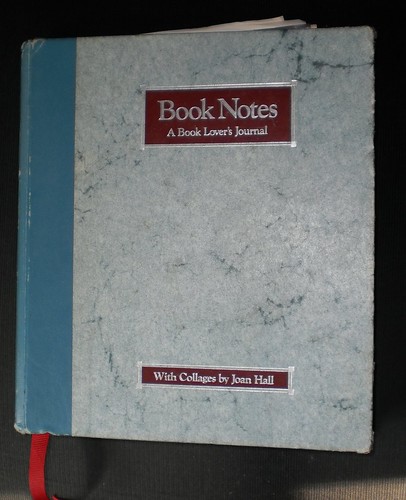
I finally decided I needed to come home and look through my book journal. A lot of serious readers whom I know have one or two or three of these. Mine dates from the late 1980's. You can see it's a bit worn on the edges.

What does this do, you ask? In this book, I kept a record of about 15+ years of the books I read. There is the title, the author, a small review and the date I read the book. In the back is a section for books lent, which I don't do unless it's a book I don't care if I don't get back, and a pocket to put clippings of books I'd like to read. This book is a bit warped because that back pocket got overfull. I finally took all the clippings out and wrote them in yet another book as one massive "To Be Read" list.

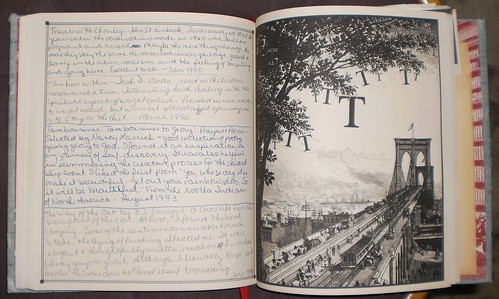
The book is organized alphabetically. The alphabet is done in a collage format with references to books beginning with that letter and, the real reason I got it, each letter is a different typeface. A small history of the typeface is given. As an example, here is the page for "T".


"T"is for trees. 

Some letters, like "B" and "D" have their sections full so I've got a smaller-in-size book that I have turned to for the overflow. It's the same principle, alphabetical sections where you can discuss books. 

I spent some time when I got home from work, rereading over a decade of literature. "Oh yeah! I liked that book. Yup. That one was a stinker." There were themes, a whole bunch of the same kind of book read one after another. There were random books. There were kids and young adult books. In the end, I found the book that fits today's theme, John Steinbeck's Travels with Charley
The "Charley" of the title is Steinbeck's dog. I'm not fond of Steinbeck's writing. I think, like Moby Dick, it's because I had to read Of Mice and Men and then the teacher for that class over did the themes of the book. Too much time was spent on it. It was at the end of the semester and I think my brain was too fried to appreciate it. 

I don't remember where I got my copy of Travels with Charley. I was looking for something reasonably quick to read, something I could shove in my purse and something that didn't lose momentum if I only read it at swimming lessons. I saw this and thought, "Ewww. Steinbeck. Oh well, it's short. I'll try it."

I read this in January of 1990 and my review is,
I was rather amazed, as I read, that the observations made in 1960 are still relevant, poignant and real some 30 years later. He talks about garbage and growth and change in cities. He discusses racism and traveling and coming home. Maybe the more things change, the more they really do stay the same at their core. 
I don't know if I still have this book or if it has long since been given away. I am wondering, having read my review, if I would think the same thing some 51 years after Steinbeck's journey. 

Beverage:  Huckleberry tea

Deb