Thursday, February 9, 2017

Things I See - Colored Glass - Part 3

Our final examination of Old St. Patrick's Church centers on the glass. Light entering a church has always been associated with the presence of the divine. You can, however, be agnostic or even atheistic and still appreciate the art of stained glass windows.

It abounds in Old St. Pat's. Transoms above doors bear not so simple Celtic knots.
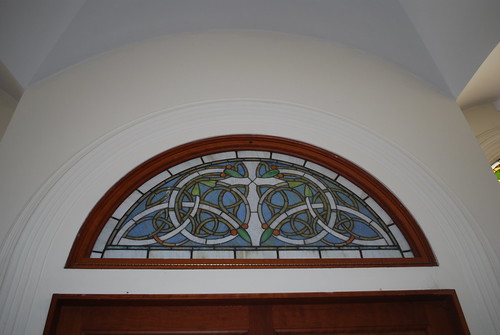

These are glass, not painted.
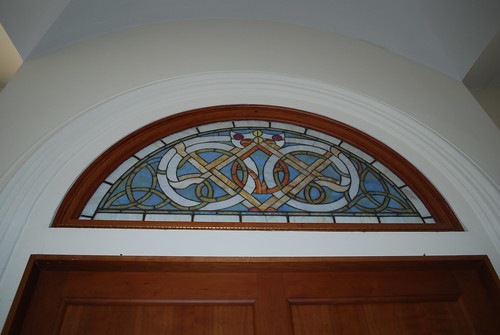

They have the defects seen in any stained glass window which has been around for a very long time; cracked pieces and cracking in the leading between the pieces. You can see the tri-cornered design in both of the windows. This is said to represent the trinity; Father, Son and Holy Spirit or Ghost.

When I do buildings containing stained glass, part of my inspection is to record the state of the windows. This means taking full-length views. This is the Annunciation of Mary.
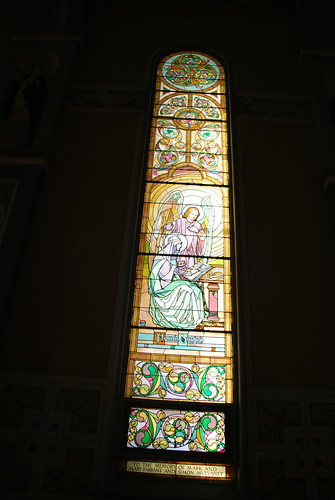

Notice the scrolled design at the bottom of the window.
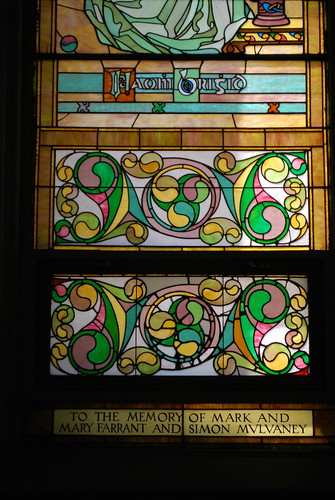

This is repeated above the main panel.
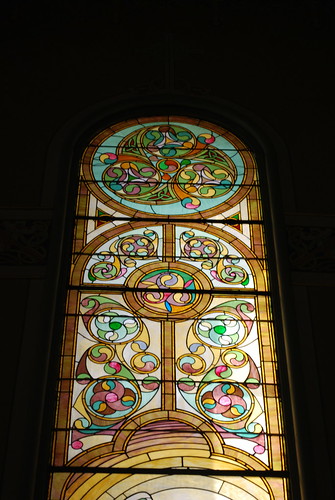

I like the juxtaposition of the almost watercolor figures with bolder colors on the top and bottom. I could see the circular design at the top of the window done as a rug or a needlework.

Here is the middle of the window; the angel
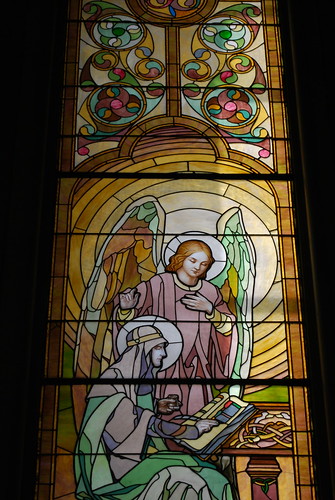

and Mary.


The faces are painted to give them depth. It's very hard to do stained glass to represent, correctly, the face. Subtle gradations in shade are just hard to do.

I present another window to show the dynamic colors.
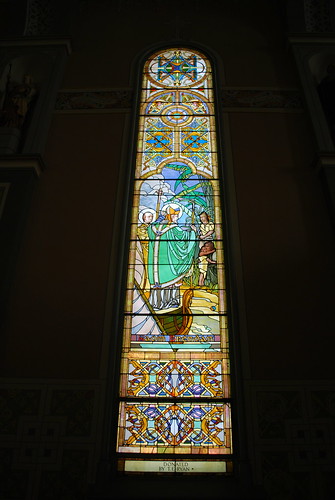

I don't remember what this commemorated. It's obviously a priest coming ashore to spread the gospel.
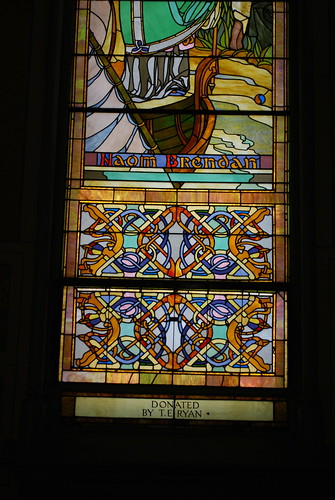

There might have been some identifying plaque near the window, but I don't remember. What I liked about this one was the colorful knots below and above the figures.
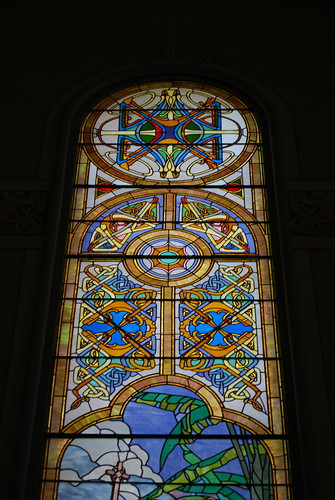

Here are the central figures.
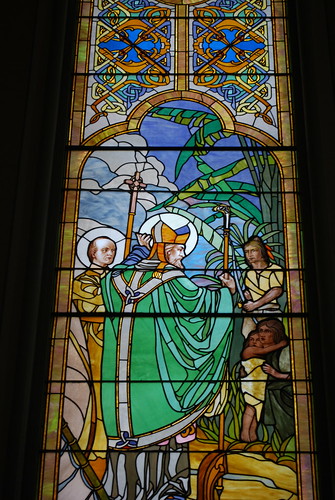

Again, their faces were painted onto the glass. The blue and yellow pieces with the color gradients were pieces of glass in their own right. I did not see paint on them.

This is a window in the choir loft.
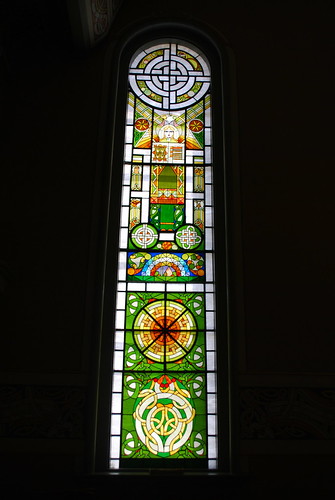

The emerald green we associate with Ireland is on display here.

There were two side alcoves at the back of the sanctuary. This one contained relics of the saints.


Above it was a stained glass transom.
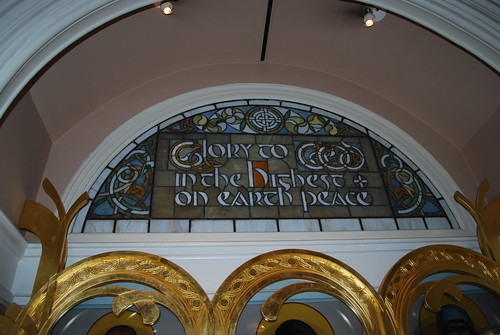

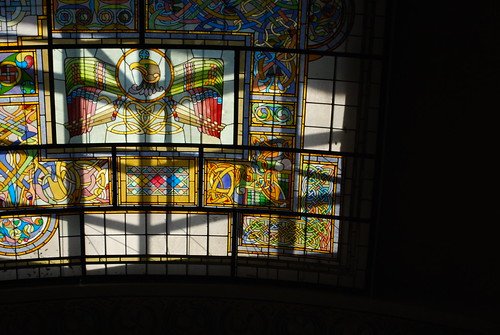
The south alcove was a mosaic-lined area with a half-dome stained glass ceiling.
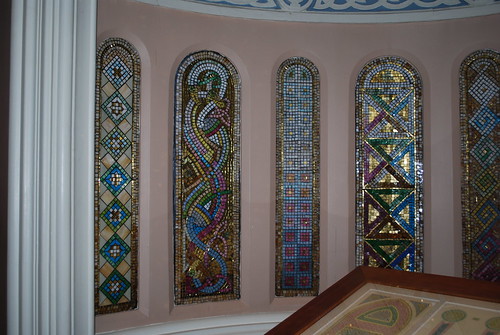

There was a sign in front of the alcove giving you a description of each panel and what it meant.


The flash from the camera caused the colored tiles to glow.


Mosaics are amazing creations. I didn't have time to spend to read up on the significance of these panels. I've always wanted to do mosaics. I admire the ability to break a design down to colored pieces of glass and to place those pieces so a larger design emerges.
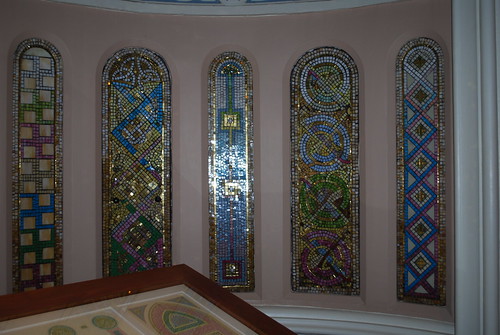

I do not know if the dome is back lit in any way. It was a bright sunny day when I did the inspection so the colors and intricacies of the dome were clear.


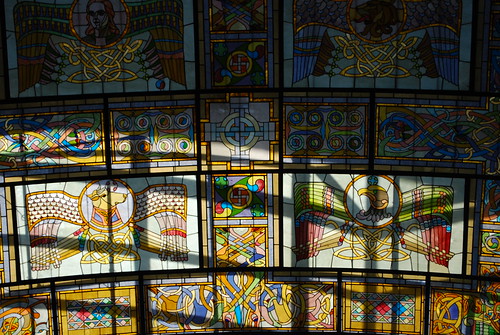
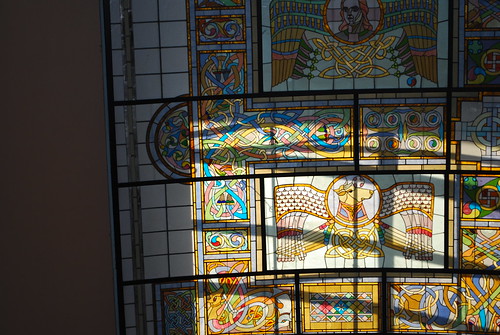
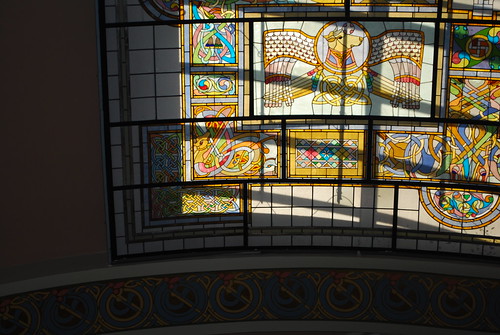
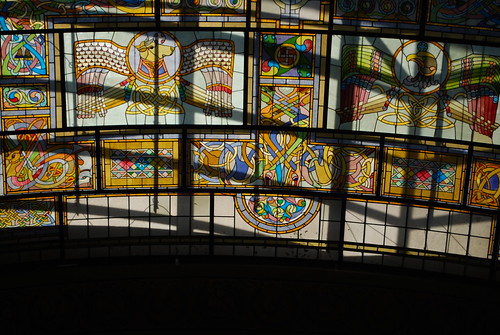
The highlight of the crafter's art was above the altar. In the post below, I showed photos of the general ceiling; the richly detailed painting and the arched choir level with it's multiple paint. The altar area had a massive stained glass panel. It's too big to document in one photo.
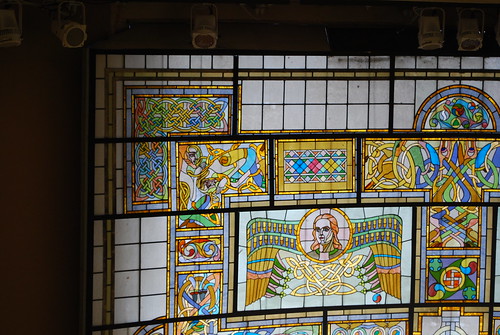

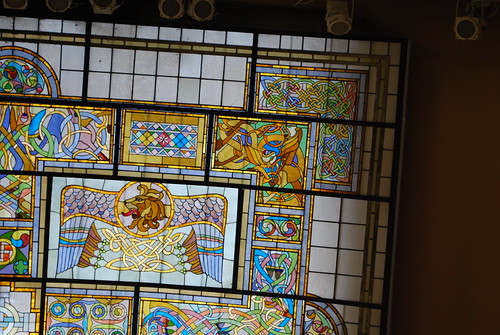

These three photos are the middle row.
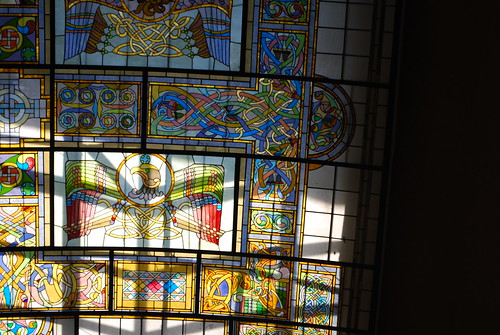


And finally, the "back" row.


Isn't that just amazing? The ceiling is reinforced and the window is protected on the outside. I do not know if it's illuminated at night. That would be an amazing sight. Imagine sitting in these pews looking up into color.
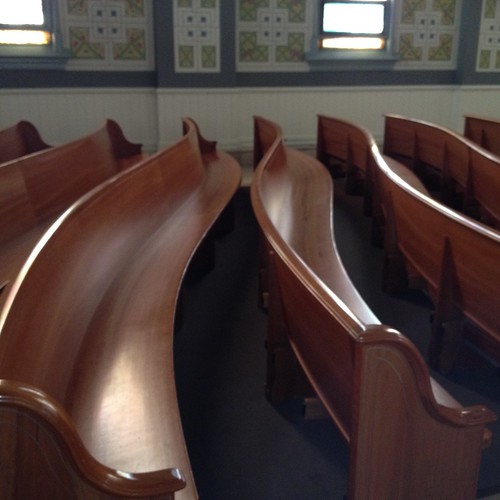

Imagine being surrounded by color. In times of anxiety, I can see this spot being a place of rest. I sat in the pews for a moment and they are quite comfortable.

This is a "working" church, meaning it has an active congregation. They had redone the basement to provide better lavatories and an acoustic ceiling in their fellowship hall for music.
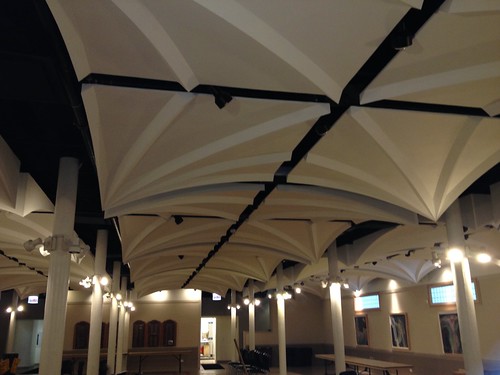

They serve a multi-ethnic congregation, although it is most Hispanic now. I had to take all this in and do my job before the noon worship service.

The church encourages people to come and be in the space.While I was there, at least a dozen tourists came, walked about and left. I felt a bit conspicuous when Catholics would come in, take a seat, kneel, and start to pray. Here I am, talking into a tape recorder. "Overviews of window number 3 on the wall 3. Crack in the lower left corner of the frame."

And, no matter how often I do it and no matter how much permission I have, I still feel awkward walking behind or up onto the altar area. It's a place of reverence and respect. Although I feel less religious than in previous years, a feel this space needs to be respected, but I have to do my job. Who is this lady with the tape recorder and the camera taking photos of the side of the altar? It's much better when the church is usually closed and I have to inspect it. Then I don't feel that I'm intruding on another's need for worship.

If you are in the Chicago area and are looking for an off-the-beaten path place of history, come here. The church is open at 9 with a noon worship. I managed to finish my work at 11:50. I saw a lot of people going into the church for that worship. The bells tolled at 11:45 and again at noon. There is a school to the north of the church, but you can't miss this since it's at the corner of Adams and Halsted. You can't count on weather in Chicago but if you get a brilliantly sunny day, you won't be disappointed in the windows.

This is one of the reasons I love my job. I get to be in places like this.

Beverage:  Assam tea

Deb

Things I See - The Design of Religion - Part 2

The interior of Old St. Patrick's church greatly reflects its heritage. There isn't much on the outside to identify it as an Irish church. Oh there's the signage and the front doors, but everything else is neo-Romanesque. If you approach the church from the west, it looks like any other older brick church in Chicago. But when you step inside, the explosion of Celtic/Irish design hits you.

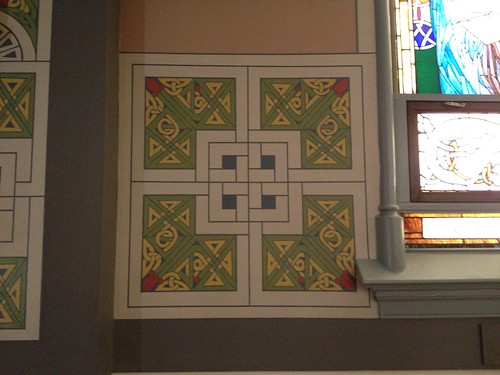
It's painted, everywhere. There are Celtic knots at the corners of the stained glass windows.


There are Celtic knots at chair rail height on walls without windows.


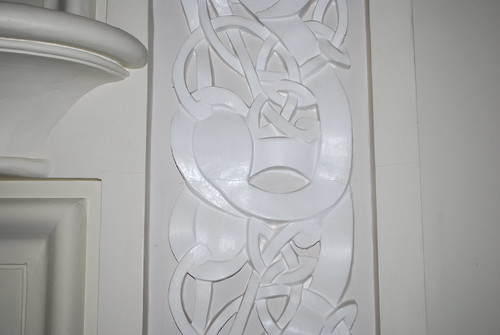
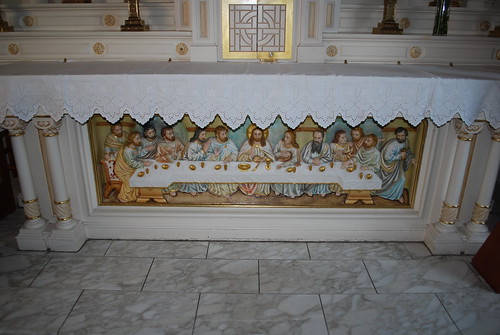
Carved wood surrounds the statues of Mary and Joseph at the front of the church.


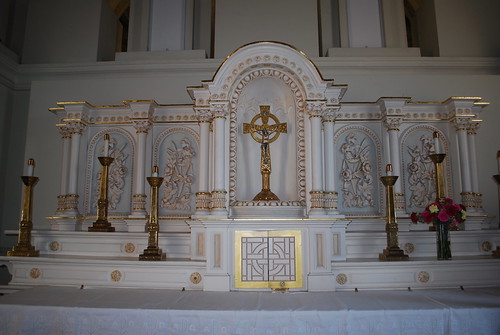
The altar itself is surrounded with this intricately carved design.


The priest's altar, behind the main altar, is not as intricately Celtic. It's more a reflection of Catholicism than of the Irish.


This, I was told, is an original piece. The front altar has been redone over the years. This has been restored several times, but is original.


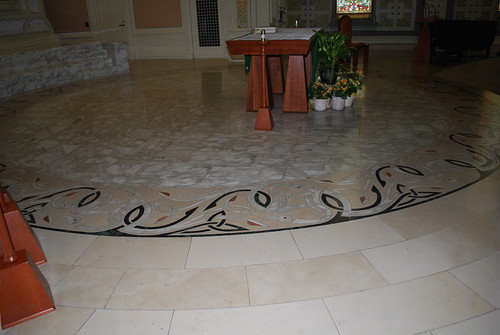
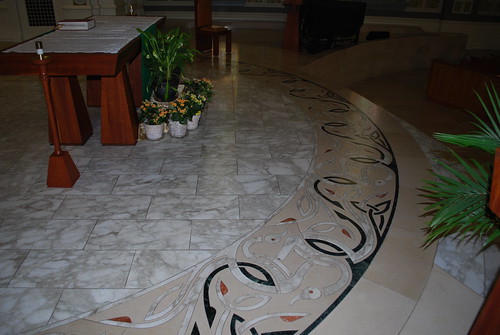
The marble floor in front of the main altar extended the theme of Celtic knots.


This is inlaid marble. It's just beautiful.


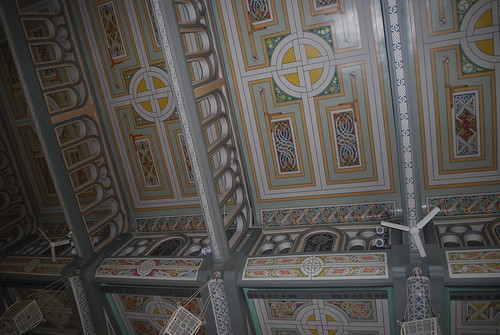
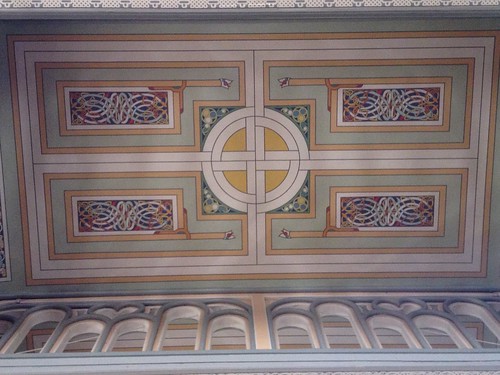
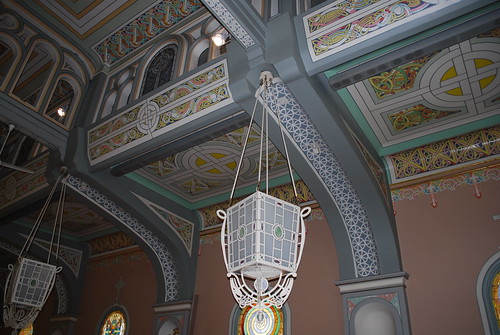
But the culmination of the integration in architecture and design is above you; the ceiling.


It is absolutely breathtaking. The mix of color. The intricacies of the Celtic designs.


Every inch of the ceiling was covered with paint of some sort.


Even the fixture covers were incorporated into the overall theme.


I wonder how often they have to do touch-ups. I didn't see much in the way of chipped paint. This place is certainly a treasure.

Beverage:  Assam tea

Deb
Friday, February 3, 2017

Things I See - Architecture of Religion, Part 1

I meant to post this last year shortly after I inspected this building but things got crazy and it never happened. But, something like this doesn't have an expiration date for blogging so here goes.

Chicago is an old city. Someone has lived in this location for, probably, a thousand years, be it Native Americans or settlers. Father Jacques Marquette and explorer Louis Joliet stopped in Chicago as they made their way up and down the Great Lakes and the Mississippi River watershed.

I'm rather delinquent in exploring the rich history of Chicago and Chicagland. I know 'of' things but that's often the extent of it. Being an introvert, the mere act of getting out of the house is a victory and although I love history, love being in historical places, going to those places can be an effort for me. So, when the inspection job takes me some place historical, it is a huge bonus. I get to be in the space; savor and soak up the history as I do my job. I also get  to "stay as long as necessary" to get a job done and that can include engaging people at the location in a discussion of the stories of the place. The Stephen Douglas memorial was one place from 2014.

A place on the radar of "history I know about but have yet to see" is Old St. Pat's Church in what is considered the "west loop" area of Chicago. It sits adjacent to the Greektown neighborhood, with the aroma of restaurants wafting through the streets when the breeze is from the south.


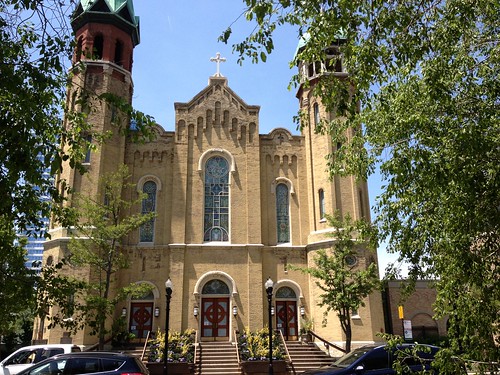
Old St. Pat's is the oldest continually active church in Chicago. A church has been on this site since 1846, founded by Irish Catholic immigrants. The current building, which you see here, dates from 1856. It survived the Great Chicago Fire. The job to which we were attached is kitty corner from this building so it was necessary to inspect the church. I drooled.

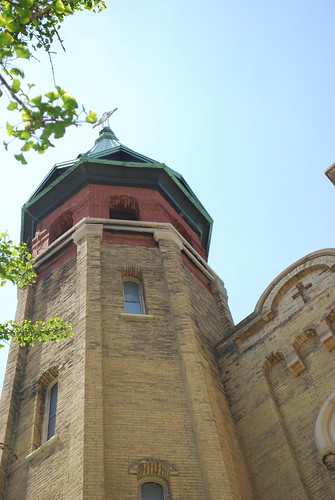
The architecture is based on the Romanesque style which dates to Medieval Europe.


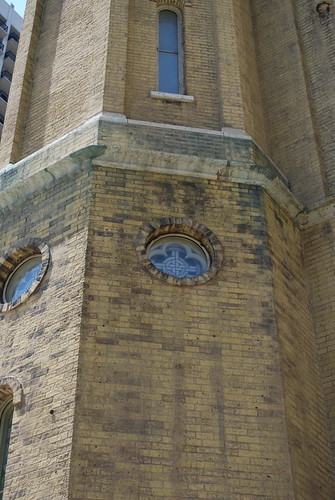
It's a symmetrical design, which you can see here in the towers which have 8 sides, with the lower part having circular windows in each wall. It's kind of a nightmare to inspect a tower like this because there aren't really "floors" as you climb.


You can see how the stairs go because of the windows.


And you see how deeply recessed the windows are, another detail of Romanesque architecture. It gives a modicum of protection from the elements to the window frames, but makes it difficult for me to check the exterior condition of those frames. I must check there is caulking around each window and that said caulking is in good condition, not cracked or deteriorated. Telephoto lenses do a good job. I don't determine if cracked caulking means the window is in danger of falling out. I just report if the caulking is cracked or missing, or if the window frame, itself, is good or has broken or rotten places, for instance. I also report on the state of the panes in a window. Are they good or, as is sometimes the case, broken. I see a lot of broken glass block windows, particularly at street or sidewalk level in basements or garden apartments.

When I was in an art history class in college, I wrote a paper on what makes a church gothic. For Romanesque style, there are the thick walls and columns, bearing the weight of the roof and the walls themselves. There is the symmetry of the octagonal spires which, although capped differently, have the same number of windows. There were the same number of windows on the side walls and something I hadn't noticed before, which, I'm sure, is on other medieval church designs.


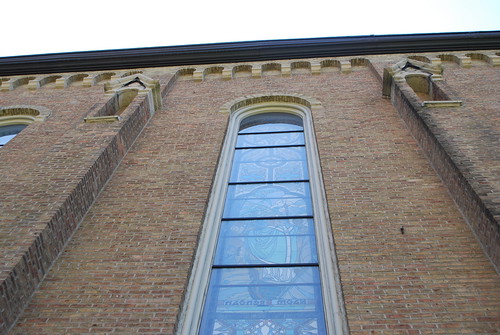
Notice the niches at the top of the columns at the roof. This is the north side of the building. Here's a somewhat close up of one of the niches from the south side.


You can see the evenly spaced, symmetrical, arches in between the columns. There are 8 niches on each side. This is a very interesting detail. At one point, statues of saints used to be in each niche. But, Chicago's harsh weather caused the statues to deteriorate faster than anticipated. So, they were removed and the niches left blank.

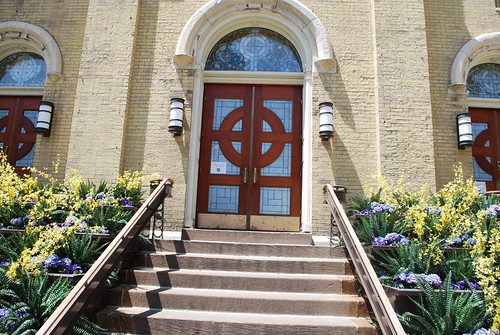
The front symmetry of the front is found with the three panels and the doors.


The doors have been replaced many times over the course of the churches history. These are the current incarnations, incorporating celtic design. The stained glass panels above the doors are original.

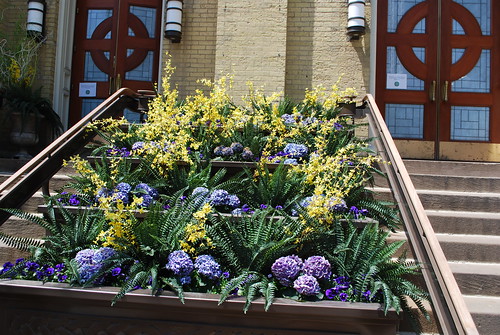
The flower beds on either side of the front door are a recent addition.


The flowers made the front so inviting.

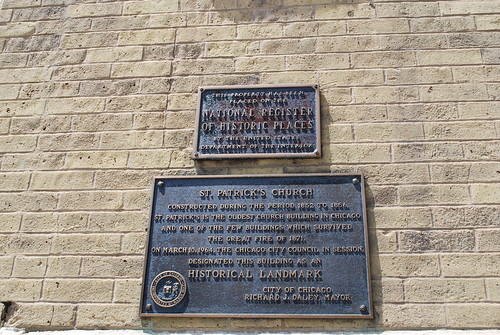
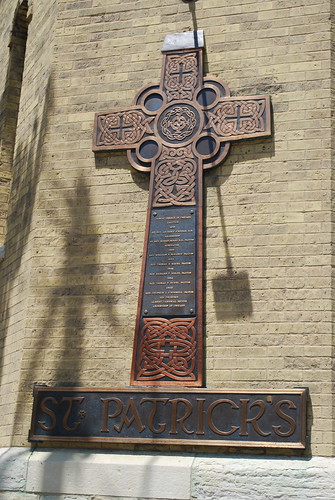
On the southeast corner, the left tower in the front photo, there is a plaque.


This briefly explains the historic significance of the church. If you like architecture and/or celtic design, you do well to swing by.


Beverage:  Water

Deb

Morning Has Broken

I saw this on the way to work this morning.


It's a sundog. They usually come in pairs, but, because I was driving, albeit slowly to get the photo, I couldn't look around to see if there was one on the right side of the sun. They form when ice crystals in the atmosphere react like prisms when the light passes through them. They are limited to cold weather and it was 12 degrees this morning.

We've come through some very gray days. The end of January was almost 2 weeks of clouds as weather system after weather system passed by, usually north of us. I can see why seasonal affected disorder takes hold. That many days without sunshine is oppressive. I don't care that it's cold. There's sunshine and a mini-rainbow. It's gonna be a great day.

Beverage:  water

Deb