The temperatures over the weekend were decidedly over 90 degrees. I actually turned on the AC for the those two days because, well, the comfort of the cats was paramount. They were afraid of the box fan which sits on the livingroom floor keeping the air at their level circulating. It took a couple days to get used to it but then Pilchard was spotted with her back to the fan, enjoying the breeze.
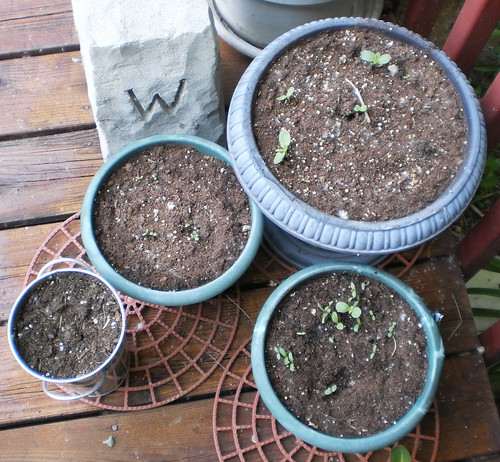
Today, the temperatures aren't expected to crack 60. It's like November or March out there. The bright sunshine and heat of Memorial Day weekend caused the plants in the flower pots to grow.
This was Saturday morning.
On Monday afternoon, they looked like this.
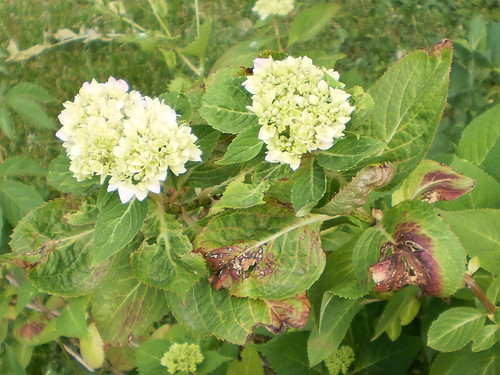
There hasn't been much appreciable growth since the weekend and with the temperatures, at night, down in the 40's, I worry, just a bit, that growth will be nipped in the bud. For example, look at the hydrangea which is off the deck.
Notice the "burned" areas on the leaves. I was concerned about that so I did a bit of research. That's the result of the record March warmth that caused the plant to bud out sooner than it should have. It's frost damage from the April into May "normal" temperatures we had. It won't affect the plant other than to make the leaves look bad. Indeed, it's got a lot of flower heads on it.
It's just been the weirdest weather I can remember this year. No blizzard. Hardly any snow. Summer in March and cold, damp weather in April and May, but not enough rain. Like us, plants are probably wondering just what the heck is going on.
This weekend, I will attempt to pull the deck chairs out of the storage unit and position them with a view of my growing seedlings. I'm reminded of a song John Denver sang on The Muppet Show.
Inch by inch, row by row Gonna make this garden grow All it takes is a rake and a hoe And a piece of fertile ground Inch by inch, row by row Someone bless these seeds I sow Someone warm them from below 'Til the rain comes tumbling down
Today would be Lewis Carroll's 179th birthday. My friend Patt, pointed this out to me earlier in the week. She doesn't care for "Alice in Wonderland", while I did my senior thesis on nonsense language in "Alice Through the Lookingglass and What She Found There", which is the full title of Carroll's 2nd work, "Through the Lookingglass".
It is in "Through the Lookingglass" that one of my favorite poems is found. It is in Chapter 6. Alice is talking to Humpty Dumpty and she asks about the meaning of the poem.
You seem very clever at explaining words, Sir,' said Alice. 'Would you kindly tell me the meaning of the poem called "Jabberwocky"?' 'Let's hear it,' said Humpty Dumpty. 'I can explain all the poems that were ever invented--and a good many that haven't been invented just yet.' This sounded very hopeful, so Alice repeated the first verse:
            'Twas brillig, and the slithy toves
              Did gyre and gimble in the wabe;
            All mimsy were the borogoves,
              And the mome raths outgrabe.
'That's enough to begin with,' Humpty Dumpty interrupted: 'there are plenty of hard words there. "BRILLIG" means four o'clock in the afternoon--the time when you begin BROILING things for dinner.' 'That'll do very well,' said Alice: 'and "SLITHY"?' 'Well, "SLITHY" means "lithe and slimy." "Lithe" is the same as "active." You see it's like a portmanteau--there are two meanings packed up into one word.' 'I see it now,' Alice remarked thoughtfully: 'and what are "TOVES"?' 'Well, "TOVES" are something like badgers--they're something like lizards--and they're something like corkscrews.' 'They must be very curious looking creatures.' 'They are that,' said Humpty Dumpty: 'also they make their nests under sun-dials--also they live on cheese.' 'And what's the "GYRE" and to "GIMBLE"?' 'To "GYRE" is to go round and round like a gyroscope. To "GIMBLE" is to make holes like a gimlet.' 'And "THE WABE" is the grass-plot round a sun-dial, I suppose?' said Alice, surprised at her own ingenuity. 'Of course it is. It's called "WABE," you know, because it goes a long way before it, and a long way behind it--' 'And a long way beyond it on each side,' Alice added. 'Exactly so. Well, then, "MIMSY" is "flimsy and miserable" (there's another portmanteau for you). And a "BOROGOVE" is a thin shabby-looking bird with its feathers sticking out all round-- something like a live mop.' 'And then "MOME RATHS"?' said Alice. 'I'm afraid I'm giving you a great deal of trouble.' 'Well, a "RATH" is a sort of green pig: but "MOME" I'm not certain about. I think it's short for "from home"--meaning that they'd lost their way, you know.' 'And what does "OUTGRABE" mean?' 'Well, "OUTGRABING" is something between bellowing and whistling, with a kind of sneeze in the middle: however, you'll hear it done, maybe--down in the wood yonder--and when you've once heard it you'll be QUITE content. Who's been repeating all that hard stuff to you?'
I was quite taken by the poem and committed it to memory. In college, one of my English professors declared that memorizing poetry increased your word power as well as brain power. Part of the final in her class was to memorize 12 lines of anything by one of the authors we read in class. I shall never forget it. 12 lines from "The Rime of the Ancient Mariner" by Samuel Taylor Coleridge.
All in a hot and copper sky The bloody sun, at noon, Right up above the mast did stand No bigger than the moon.
Day after day. Day after day. We stuck, nor breath nor motion. As idle as a painted ship Upon a painted ocean.
Water, water everywhere And all the boards did shrink Water, water everywhere Nor any drop to drink.
The very deep did rot, oh Christ That ever this should be. And slimy things did crawl with legs Upon a slimy sea.
Yes, that is from memory. I can recite Jabberwocky, too, but I won't. I do agree with that English teacher even if I find myself standing more often in the center of a room wondering why I came in here. Memorization is good for you. I don't think kids are challenged enough in school to do that. Oh yes, we have to memorize facts and dates and formulas and all sorts of things, but memorizing poetry expands your mind.
This is a great book, if you are looking to challenge yourself to memorizing poetry. It's in my "to be read" pile. I bought it when it came out. I've memorized a lot of things since then, some might be in this book. I admit to not opening it in years, but the collected poems were, from what I remember, great examples of poetry.
You also couldn't go wrong with memorizing lines from some of Shakespeare's soliloquies. I memorized Antony's oratory over Caesar's body. "Friends! Romans! Countrymen! Lend me your ears! I come to bury Caesar, not to praise him. The evil men do oft lives after them while the good lies interred with their bones. So let it be with Caesar." That's all I remember from that. And I did know most of Hamlet's "To be or not to be. That is the question. Whether 'tis nobler in the mind to suffer the slings and arrows of outrageous fortune or to take arms against a sea of trouble and, by opposing, end them.", but I've forgotten parts of that, too. These soliloquies are probably still with me. I'd just need prompting to remember them in totality.
Lewis Carroll wanted to be a mathematician but there was no money to be made in that profession. So, he became a minister. In his poetry, you can see the results of mathematical study. It is, once you get past the odd words, easy to memorize "Jabberwocky", just as it's easy to memorize the rhyming couplets of Coleridge's "Ancient Mariner". (You should read the whole poem if you haven't. It's quite the tale of redemption.)
I leave you with one of the funniest versions of "Jabberwocky" I've ever seen.
Woke up to the news that jazz great Lena Horne had passed away. I have two songs in my collection by her; "New Fashioned Tango", which is a slightly silly ditty, and her signature song, "Stormy Weather". This link takes you to the YouTube of her singing the song from the movie of the same name.
The following, while probably not considered at the top of her resume, brought Ms. Horne to a wider audience.
Lena Horne on The Muppet Show. Part 1. Part 2 and Part 3. Given her life, the song selection in the show could be considered autobiographical.