The past two weeks were filled with a project in Rock Island, Illinois. It's "merely" a 2 1/2 hour drive from the house to the project so I could drive out and back in a day. Of course, when a day starts at 7 a.m. and doesn't end until 9 p.m., and the next day I am riddled with exhaustion, I have to question what the heck I'm doing to myself.
But, I got up and drove, several days running, to Rock Island. You get to know the road when you're on it so much. I came to know where I could turn to avoid some things and I finally saw the campus of Augustana College.
If you don't know Rock Island, it's part of what's called the "Quad Cities". This encompasses Rock Island and Moline on the Illinois side and Davenport and Bettendorf on the Iowa side. The cities have spread so East Moline and Silvas, on the Illinois side, meld together with Moline. As I traveled through each city, the ancient nature of these river towns became apparent. There are buildings and homes that date from the late 1800's. Manufacturing, because the Mississippi River made it easy to procure goods and ship them out, was huge in the area. John Deere's corporate headquarters and manufacturing facilities are still in Moline.
So, it shouldn't have come as a surprise that I passed by a rather old graveyard. The highway, Illinois 92, splits to become one way in either direction around this graveyard, which is attached to a park. When I first passed by, it was Spring Break, and there were people fishing in the pond in the park. There are picnic facilities and what looks like an historical building on the property. It looks to be a very nice public park.
The thing that bothered me about this was one lone gravestone I saw as I headed south. You can't see it in the debris of the shoulder.
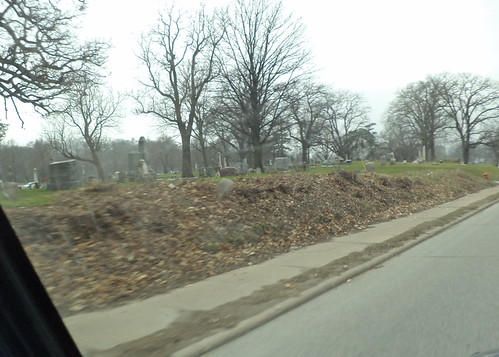
There are a lot of old stones in this graveyard and this stone appears to be old as well. Here's a photo with the marker highlighted.
I discovered, in chatting with people on the job, that the Quad Cities had a Civil War prisoner of war camp. It was located on ground where the Rock Island Arsenal is. There is a marker to the camp on the arsenal grounds. Many black families in the Quad Cities can trace their ancestors to men who came to the camp as workers or guards. I didn't know any of this.
The gravestone in question doesn't appear to be of pre-1920's vintage, but it's possible it is. In any case, I wonder if there is a vault or, at the very least, a casket attached to the parcel where the stone is. It seems more than a little disrespectful that this stone is askew. It's also probable, given the stone's tilting with the erosion of the shoulder, that there is no family left to care whether it remains upright or tilts farther to the right.
I can't find, in the City of Moline's web site or on Google, a list for the name of the park or the cemetery. This could be a case of not having sufficient funds to move the grave so further erosion doesn't reveal more than just plant roots. Still, I'm kind of surprised it's left like this. I hope there are plans to fix it.
Beverage: Water
Deb
Showing posts with label grave. Show all posts
Thursday, April 16, 2015
Saturday, July 19, 2014
Embarrassment - I Didn't Know About This
It's probably happened to you, particularly if you live in proximity of an urban environment. You live for some 30 years in one location and you think you know the place pretty well. Then, a client calls and says, "We're replacing this foot bridge over the railroad tracks at 35th Street so we need you to inspect the Douglas Tomb." The what now?
The Stephen A. Douglas Tomb, an Illinois Heritage Site, on a small patch of land off south 35th Street in Chicago. I looked at my boss and he looked at me. He can be excused. He's only lived in the area for 7 years. I however, ...
You all know Stephen A. Douglas, right?
He was famous already before he debated a young state senator by the name of Abraham Lincoln. You might have heard of him. They debated a total of seven times across the state leading up to the election of 1858. Douglas defeated Lincoln to retain his seat in the US Senate.
He was hugely instrumental in the Compromise of 1850, which was to have "settled" the issue of slavery once and for all. He believed, very strongly, in the right of the populace to decide the laws under which they would live. He never came out against slavery. He was always arguing for the preservation of the union over anything else. His opposition to the Dread Scott decision by the Supreme Court gained him the Democratic nomination for president but split the party in two, creating a southern Democratic party. This paved the way for Lincoln to win in 1860.
I assumed he was buried downstate. He was born in Vermont. He and his first wife, who was the daughter of a slave owner who had a plantation in Mississippi, moved to Chicago in 1847 to take advantage of the new town's growth. After his defeat in the presidential election of 1860, he tried to find a compromise to the impending secession. He offered to mediate any meetings to keep the union together. Once Fort Sumter was bombarded, he read over Lincoln's call for troops to put down the rebellion. Lincoln asked for 75,000 men. Douglas disagreed and urged Lincoln to ask for 200,000 men. "You do not know the dishonest purposes of these men as well as I do," he told Lincoln.
He was in Chicago in the spring of 1861 when he contracted typhoid fever and died in June. He was buried on land he owned on the south side of Chicago. Leonard Volk was hired, in September of 1861, to be the custodian of the grave site and he began the business of raising funds to build a suitable memorial. What is on the site is a scaled back version of what Volk initially proposed. The cornerstone was laid in 1866 with formal dedication later in the year. But, financing a war and with it President Johnson's spending in office shut down construction for several years. The state of Illinois was asked, repeatedly, to chip in $50,000 to finish the tomb. Due to foot dragging (Imagine that), the bill languished and so, therefore, did completion of the tomb.
Finally, in April of 1881, the necessary funds were appropriated by the state and the tomb was finished. It's a square monument on a circular base. There is a statue of Douglas on the top of the column. Below the column are bronze bas-reliefs depicting Native Americans, pioneers, commerce and education.
There are also four bronze statues off the corners of the monument.
They represent justice, history, eloquence and Illinois. The monument is limestone.
You can view Douglas' tomb via an entry on the east side.
When the monument site is open, there is a caretaker available to talk about the tomb and Douglas' life. I was there during unofficial time, which was great for being able to do my job, but not so good for wanting to know about the tomb and its construction. There is no door so you can see inside to the tomb itself and the bust which rests on the tomb.
It's in wonderful condition considering some of these stones are over 100 years old. I apologized to Senator Douglas for having to take photos of his final resting place. I found a couple of chips in the limestone of the monument and general cracking of the caulking between the stones. The Illinois Historical Society believes this is the oldest state memorial. There are benches to sit and gaze at the monument.
I have to go back to this area for more inspections so I'm going to try to time my travels to when there is someone at the site to talk about the tomb. I just want to hear what they have to say. There was a Union prisoner of war camp near this location, on 160 acres of land the Douglas family owned. I knew of this camp, but I didn't know exactly where it was located.
So, I was thrilled, once I learned where this was, to be given the chance to inspect it. I also am embarrassed to admit I didn't know about this. It takes longer to get here than to tour the monument but it is a gem.
Beverage: Huckleberry tea
Deb
Thursday, August 13, 2009
This could be good.
Not to give too much away, but a job from Northeast Iowa landed in our lap for bid this afternoon.
I know exactly where it is and I know the company putting out the bid. When we would go visit my late in-laws, we would go right by the company's offices.
If we get the job, it's going to require at least one trip out there to do some inspections and set up equipment and one trip out there to monitor the initial blast.
I'm excited. It's near my hometown, not that I have anyone I'd visit there other than the graves of my relatives. I know that probably sounds morbid, but I have yet to find my great-great grandmother, Anna's grave. It's in the oldest part of the cemetery. If I have some down time, I should put flowers on my dad's grave and see if I can find Anna's grave.
Plus, if this goes into a weekend, I can watch on local TV my Iowa Hawkeyes play football. Depending upon the time frame, this could happen during the fall when the trees explode in color beyond your dreams. "Autumn in New York" is an old jazz standard. It's nothing compared to autumn in Northeast Iowa. We like to say God made New England first and then made Northeast Iowa to do it right.
Keeping my fingers crossed.
Beverage: Blackberry Sage tea
Deb
Labels:
Anna,
autumn,
cemetery,
dad,
football,
grave,
inspections,
Iowa,
Iowa Hawkeyes,
Jazz,
Monona,
New England,
Northeast Iowa,
work
Subscribe to:
Posts (Atom)


